Who’s who
- Carl Gunnerius Aamodt, born at Lille Åmot in Trøgstad in 1868. In America he signed himself Carl G. Amoth. Pete Amoth’s grandfather.
- Gudbrand Gudbrandsen and Karen Kirstine Torkildsdatter, his parents, married in Trøgstad in 1867. He came from Tveter in Ullensaker, she from Studserud in Høland. The family tree calls him Gulbrand.
- Thorvald, “Tom” (Torval in Carl’s letters), born in 1870, and Martin, born in 1872: the brothers who followed him in 1889.
- Gudbrand Arnt, born in 1881, the brother who stayed and took over the farm.
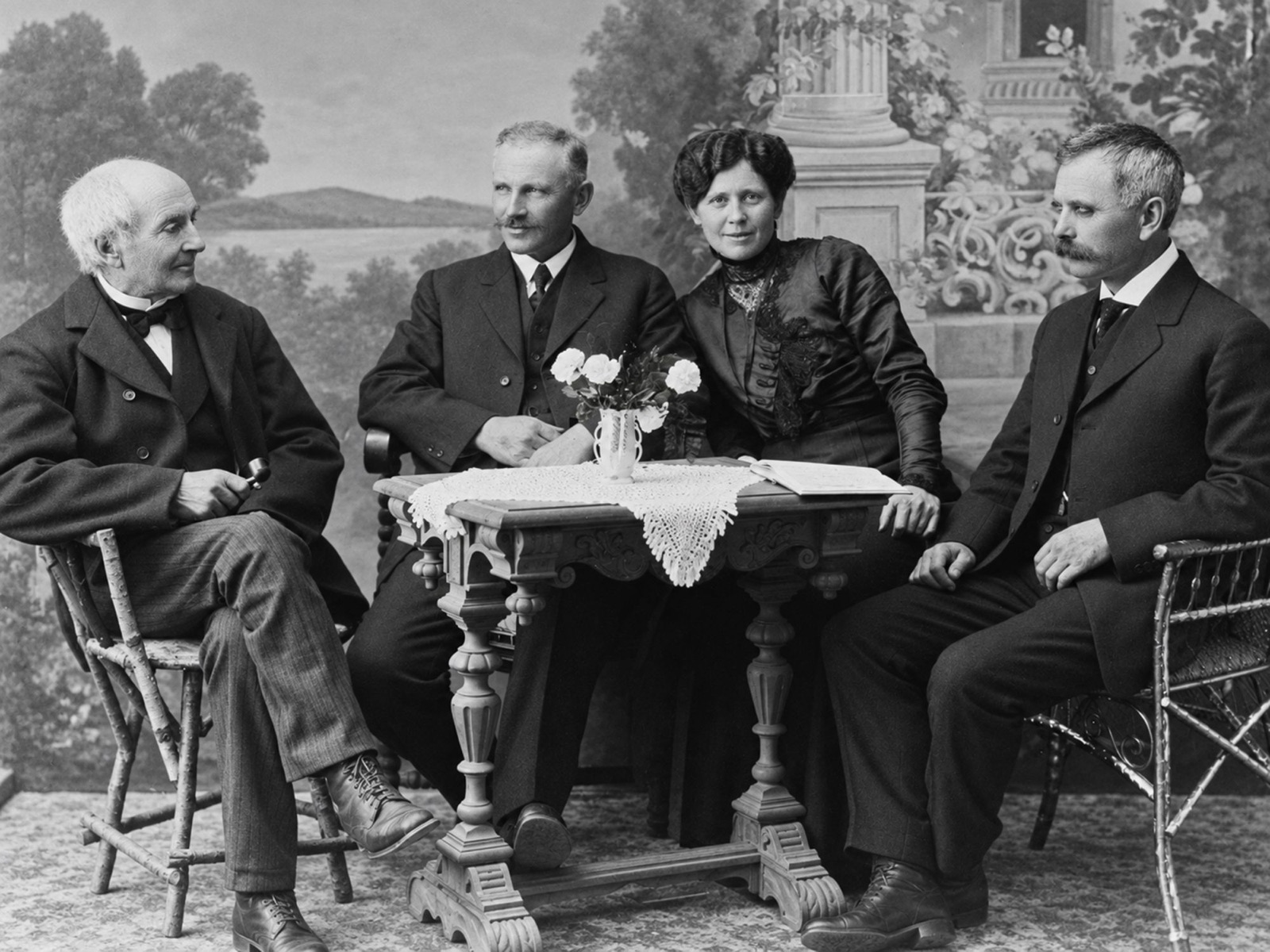
- Nikoline, “Lina,” their sister, who married Rudolf Mansrud, a photographer at Askim and Mysen.
- Mina Pederson, whom Carl married in Minnesota in 1893.
Lille Åmot
Carl Gunnerius was born on July 6, 1868, and baptized in Trøgstad church on August 23. The register gives his parents’ home as Lille Aamotplads. Gudbrand Gudbrandsen, a widower of thirty-seven from Tveter in Ullensaker, had married Karen Kirstine Torkildsdatter, twenty-four, from Studserud in Høland, the September before.
Åmot means a place where waters meet. Hans Veiby’s 1914 history of Trøgstad has a good-sized stream joining the Hæra river at the Åmot farms. Lille, “little,” set this one apart from Store Åmot.
Plads usually means a crofter’s place, rented from a bigger farm, and the family has read the baptism that way. The 1875 census says otherwise. It lists Gudbrand as gaardbruger selveier, a farmer who owned his land. That December the household was Gudbrand and Karen, Carl, seven, his brothers Thorvald, Martin and Christian, and a maid born in Sweden, Anne Olsdatter. A shopkeeper, Johan August Østby, and his brother Fredrik lived at the same place. The farm kept a horse, two cows and a calf, and that year it sowed six tønner (barrels) of oats, three of potatoes, a little rye and barley, and grass seed.
Veiby also tells of an old paper kept at Åmot about the woods on the heights east of the farm, which were held in common. Each year a plot could be cleared and burned and sown with rye, and after the harvest the fence came down. He doesn’t say which Åmot kept it, or when.
Carl was confirmed in Trøgstad on October 7, 1883, as Karl Gudbrands Aamot lille, and marked meget godt, very good. A later hand added beside his name: 1888 udfl Amerika, left for America in 1888.
Spring 1888
On May 24, 1888, Carl signed on with an emigration agent, A. Helgesen, in Christiania. The police register of emigrants has him as Karl G. Aamodt, twenty, a laborer from Trøgstad, bound for Chicago. His passage is marked Ppd., prepaid. Who paid for it isn’t recorded. He was in fact nineteen, six weeks short of his birthday.
The next day he sailed on the Rollo, which ran by way of Kristiansand to Hull. It was the same ship Knute Stenerson had taken a year earlier. From Hull, emigrants crossed England to Liverpool, most likely by train.
There the record thins out. The American Line’s British Prince, Liverpool to Philadelphia, has a passenger list dated June 12, 1888, with a Carl G., twenty, a laborer bound for Chicago, his surname read as Amamont. Philadelphia fits: in 1894 Carl gave it as the port where he landed. But the same list has this passenger from Sweden, and Carl gave the month as July. It’s probably Carl, and not proved. The Philadelphia Inquirer reported the British Prince coming up the Delaware on June 11.
His obituary says he came at twenty and settled first at Franklin, in Renville County, Minnesota. Whether he ever got as far as Chicago isn’t known. Tom came the next March and Martin in May, both by way of Philadelphia, by their own later statements. The Wales history has all three crossing together, and Carl born in 1869. The records have him born in 1868 and crossing a year before his brothers.
Carl G. Amoth
On November 5, 1894, at the district court in Renville County, Carl declared that he meant to become a citizen. He signed it Carl G. Amoth. Tom signed just below him, also Amoth. Martin, on the next page, signed with his mark, and Carl witnessed it. Carl’s page has him born in Finland and a subject of the Czar of Russia, which he wasn’t. His port was first written Sault Marie, with Philadelphia above it as a correction. How the mistakes got there isn’t known.
He finished in Cavalier County, North Dakota, on October 15, 1900, renouncing the King of Norway and Sweden. His witnesses were T. Amoth and M. Amoth.
What each record calls him:
- 1868, his baptism: Carl Gunnerius.
- 1875, the census: Carl G. Gudbrandsen.
- 1883, his confirmation: Karl Gudbrands Aamot lille.
- 1888, the emigrant register, as indexed: Karl G. Aamodt.
- 1894, his declaration, in his own hand: Carl G. Amoth.
- 1895, his son Guy’s baptism, Fairfax, Minnesota: Carl og Mina Aamodt.
- 1924, the burial register of Our Savior’s, Wales: Carl (Amoth) Aamodt, with Gunnerius written above.
Karl is the confirmation clerk’s spelling, and the index’s reading of the 1888 register; he signed Carl. Amoth was his by 1894, but the church never quite caught up, and the two names run side by side for thirty years. The family story that a pastor gave him the spelling isn’t in any record found so far.
1914
On July 10, 1914, Tom Amoth, forty-four, and Carl Amoth, forty-six, landed at New York on the Lusitania from Liverpool, listed together among American citizens coming home. Their mother had died the year before. The history of Our Savior’s church names its building committee that spring, the last of them “to act until Carl Amoth returned from Norway.”
The brother who stayed
Gudbrand Arnt was born on January 8, 1881. The 1910 census has Arnt farming Lille Åmot, farm number 97, holding 1, as its owner, with his father, Gulbrand, eighty, and his mother, Karen, living there in retirement. A 1956 family history by Harald Sletner says he took the farm over in 1907, sat on the municipal council and the tax board, and took a strong interest in Christian affairs. He married Karoline Bolette Johansdatter of Hedemarken in Hærland on June 21, 1912.
The farm book Norske gardsbruk describes Lille Åmot twice, each time with a photograph. In 1942: 94 dekar of fields (about 23 acres) and 200 of forest. In 1965: the farmhouse from about 1790, the barn from 1895, and Karl Langsæther farming it, married to Arnt’s daughter Kirsten. They took over in 1946.
What the records don’t say
- Why Carl left. Nothing he wrote says, and the farm wasn’t lost: his brother farmed it, then his niece.
- Who paid for his ticket.
- Which ship took him across the Atlantic. The British Prince is likely, not proved.
- When Gudbrand got Lille Åmot. The farm book says he bought it in 1860; older family notes have him at Tveter in 1865. The deed hasn’t been read.
- How Amoth began.
How we know
- Carl’s baptism, Trøgstad, 1868, ministerialbok I 9, p. 47, no. 80 (National Archives of Norway ↗).
- His parents’ marriage, Trøgstad, September 7, 1867, ministerialbok I 9, p. 220, no. 11 (National Archives of Norway ↗).
- The 1875 census, Trøgstad, Havnaas district, Lille Åmot: the household (page ↗) and the farm’s animals and seed (page ↗), National Archives of Norway.
- His confirmation, Trøgstad, October 7, 1883, ministerialbok I 10, p. 114, no. 13 (National Archives of Norway ↗).
- The emigrant register, Christiania police, 1888–1890, folio 4, second line: contract May 24, sailing May 25 on the Rollo (the page ↗, the index ↗, National Archives of Norway). The Rollo’s route is from Norway Heritage ↗.
- The British Prince’s passenger list, Philadelphia, June 12, 1888, U.S. National Archives T840, roll 11, p. 298, row 12 (passenger page ↗, cover ↗, Ancestry, account needed), and The Philadelphia Inquirer, June 12, 1888, p. 6 (Newspapers.com ↗, account needed).
- The declarations, Renville County district court, volume B, November 5, 1894: Carl’s and Tom’s on p. 282 (FamilySearch ↗), Martin’s on p. 283 (FamilySearch ↗), free account needed. FamilySearch’s typed reading of these pages is unreliable; the images aren’t.
- His naturalization, Cavalier County district court, October 15, 1900, court page 345 (Ancestry ↗, account needed).
- Guy’s baptism, Central Lutheran Church, Fairfax, Minnesota, January 17, 1895 (Ancestry ↗, account needed).
- The 1910 censuses: Carl’s household in Moscow Township, Cavalier County, which gives his arrival as 1888 (Ancestry ↗, account needed), and Arnt’s at Lille Åmot (National Archives of Norway ↗).
- The Lusitania’s list of returning citizens, New York, July 10, 1914, p. 65, rows 8 and 9 (Ancestry ↗, account needed).
- His burial, Our Savior’s Lutheran, Wales, North Dakota, 1924, p. 160 (Ancestry ↗, account needed).
- His obituary, Cavalier County Republican, May 8, 1924, from the family’s typed copy: given in full here.
- Wales and the Surrounding Area, 1897–1997 (1997), pp. 294–312: the church’s history and the family’s own accounts of Carl, Tom and Martin.
- The books, read at the National Library of Norway: Hans Veiby, Trøgstad herred 1814–1914 (1914), pp. 9 and 45 (National Library of Norway ↗); Norske gardsbruk, vol. 3, Østfold (1985), reprinting the 1942 and 1965 entries for Lille Åmot with their photographs (1942 ↗, 1965 ↗); and Harald Sletner, Tårneby (Torneby) og Mosebyslekten (1956), chapter 8 (Rømskog Historielag ↗).
- Arnt and Karoline’s marriage, Hærland, June 21, 1912 (National Archives of Norway ↗).