Helle is in Veggli, a little over a kilometer north of Tveiten and about two north of Kjemhus. The old spelling is Helde. It isn't the Helle in Rollag parish, farther down the valley, which has a family history of its own. The family's part of it was Søre Helle, the southern farm.
Stener and his clocks
Stener Ingemundsen grew up at Kittilsland and learned clockmaking at Kleiverudhågån in Rollag, in Modum and at Kongsberg. In 1825, the farm history says, he bought southern Helle for 350 speciedalerdaler The silver money Norway counted in before the krone of 1875: the riksdaler, and from 1816 the speciedaler. In the 1830s a farm in Veggli sold for a few hundred speciedaler. All the words. It needed a lot of work, and he rebuilt it. He kept his workshop in the main house.
He numbered his clocks. The farm history's count runs to 212. Its second volume says 213. Either way, more than two hundred clocks came out of one farmhouse in Veggli.
At least one is still around. In 2023 the local historian Even Tråen posted a painted clock to a Numedal folk-art group, its dial signed "Stener Helde, Wegli No 96." He thinks the dial was painted by Sebjørn Kverndalen. A clockmaker didn't necessarily paint his own faces. Stener made the works, and the decoration could be another man's.
In February 1829 Stener married Birgit Knudsdatter of Tveiten. His brother Kittil had married her sister Ambjør eight years before, so two Kittilsland brothers had married two Tveiten sisters. Their son Ingemund was born at Helle that June. Six more children followed, the farm history says. One of them, Knut, made clocks too.
Stener died in 1867. Birgit lived until 1875.
The coaching station
Ingemund married Ragnild Svensdatter in 1855, and they started out on Lillehøiset, south of Kjemhus. In 1867, the year Stener died, they moved to Helle with their children. The photograph of the family is from about a year later.
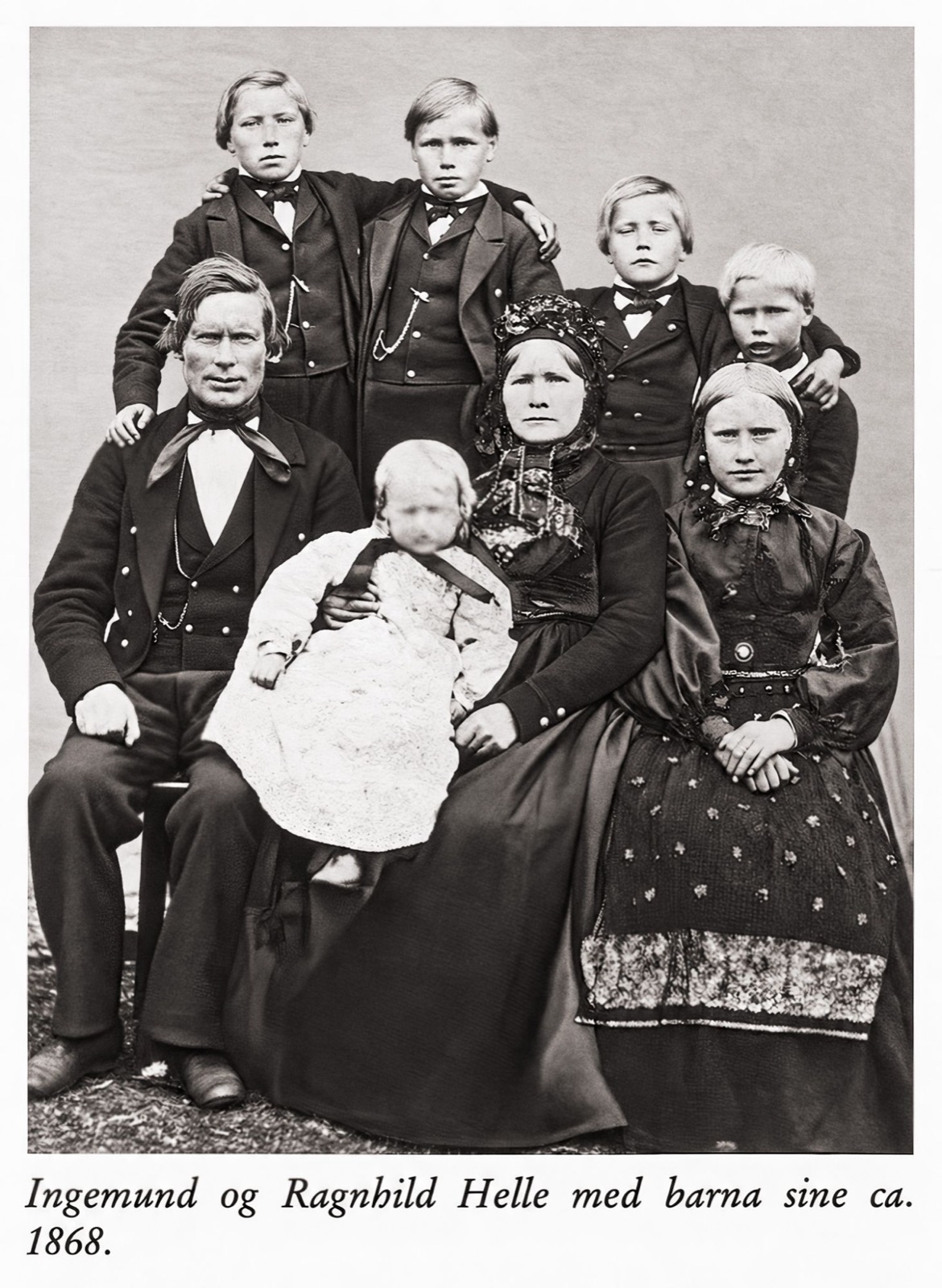

From 1877, the farm history says, Helle was a coaching station. Travelers on the valley road changed horses here, and the post came through. The station ran until 1913. Ragnild died at Helle in 1892, Ingemund in 1908.
Their sons didn't stay. Knud left in 1887 and became Knute Stenerson, named in America after his grandfather the clockmaker. With his brothers Svend and Gunder he built Stenerson Bros., lumberyards across the Red River Valley.
A Stenerson clock once stood at the company's yard in Moorhead, a comment in that same 2023 discussion recalls. Whose it was, whether Stener made it, and where it is now, nobody has said. If you know, write.
The smithy
Most farms here had a smithy, for scythes, horseshoes, nails and the tools of the fields and the forest. The one from Søre Helle, built about 1840, when Stener had the farm, now stands at Rollag bygdetun, the open-air museum. The museum doesn't say who built it. Stener's clocks were made in the house.
Who lived here
born or died at Helle · a pale bar is a life whose start isn’t recorded
Show them as a list, with what puts each of them here
- Ingemund Stenersen 1829–1908 · born here; died here
- Stener Ingemundsen 1852–1854 · born here
- Stener Ingemundsen Helle 1857–1899 · lived here; named for it
- Svend Ingemundsen 1859–1936 · lived here
- Bergith Ingemundsdatter 1867– · born here
- Ingemund Ingemundsen 1872–1951 · born here
The records
- 1829. Stener Ingemundsen and Birgit Knudsdatter married, February 12. Rollag ministerialbok: the record.
- 1829. Ingemund, son of Stener and Birgit, baptized June 14: the page.
- 1855. Ingemund Stenersen and Ragnild Svensdatter married in Veggli, April 26: the page.
- 2023. The clock signed "Stener Helde, Wegli No 96": Even Tråen in the group Målarkunst i Numedal, September 20, the post. The dial painter is his "probably."
The farm history: Knut Hoff, Rollag bygdebokbygdebok (plural bygdebøker) A Norwegian local history, usually a few volumes per district, going farm by farm through who lived there and when. Compiled from church registers, censuses, probate, tax and court records. The Kjemhus line comes from the ones for Flesberg and Rollag. All the words, vol. 1 (1988), pp. 129–135, at the National Library; vol. 2 (1989), pp. 92–94, for the count of 213. The smithy: Rollag municipality's guide to Rollag bygdetun.