The dot is the farm’s probable place; the map register names more than one spot that could be it.
Water © OpenStreetMap contributors · farms placed from Kartverket
Kjemhus lies just southwest of Veggli church, where the old riding road up Numedal met the Nordmannslepa, one of the main trails over the mountains to Tinn. Every autumn drove-leaders, farmers and buyers from Hardanger, Voss, Tinn and Numedal met at the market on Kjemhushaugen, and more than cattle changed hands: land was sold there and money lent. Above it lies a burial ground of about fifty mounds, probably from the Migration Period. The farm is named in a record of 1488. In 1680 it was split in two: Søre Kjemhus kept the old farmyard, and Nordre Kjemhus, the family's half, was built new beside it.
Steinar
Steinar Halvorsen was born at Gladheim, a short walk south, in January 1802. For years he traveled as a peddler. In Seljord he met Guro Vefall, who had a child about 1830 and named him the father. He denied it, and the paternity case that followed was long and ugly, the farm history says; both villages talked, and someone made a song about it. A complaint against "Stener Halvorsen Glaim" was heard at the Rollag parsonage on October 8, 1834, and sent on to court.
He was something of a wild man for a while, summoned before the conciliation commission and the court for reckless conduct. He was also a good fiddler. In 1833 Hellek Gunnulfsen Vindegg smashed his fiddle. They settled: Vindegg paid 7 speciedalerdaler The silver money Norway counted in before the krone of 1875: the riksdaler, and from 1816 the speciedaler. In the 1830s a farm in Veggli sold for a few hundred speciedaler. All the words 2 ort in damages and a fine of 2 speciedaler 3 ort. Some old fiddle tunes from West Telemark are still called Gladheimen, and Numedal's folk musicians think they may be his.
In 1832 he married Kari Tollefsdatter of Kjøntveit in Nore, and on June 25, 1835, he bought Nordre Kjemhus from Ole Knudsen for 300 speciedaler. The deed survives in the land register. In 1839 he bought Landrud at auction too, and in 1862 passed it to his son Tollef. He and Kari, the farm history says, lived in a style that tasted of a large estate.
About 1860 the main house was restored, partly with timber from the old Veggli church. Next door at Søre Kjemhus, two painted boards from that church, from about 1760, are fixed in the living-room wall: cows, horses, a rooster, a capercaillie and a rider in a top hat.
Steinar died at Kjemhus on August 7, 1864, aged sixty-two, and was buried in Veggli churchyard on August 13. A cast-iron cross was put on his grave, perhaps the first in the old churchyard, the farm history thinks. It was still there in 1981, when Norges kirker, the national survey of Norway's churches, listed it: open Gothic tracery in the ends of its arms, over "Stener Halvorsen Kjemhuus d. 1864". His brother Per's cross, from 1878, is its twin. In April 2014 it was still standing in the long grass of the old churchyard, west of the church: "Here beneath rests the dust of Stener Halvorsen Kjemhuus, baptized 17 January 1802, died 7 August 1864. Blessed be your memory."
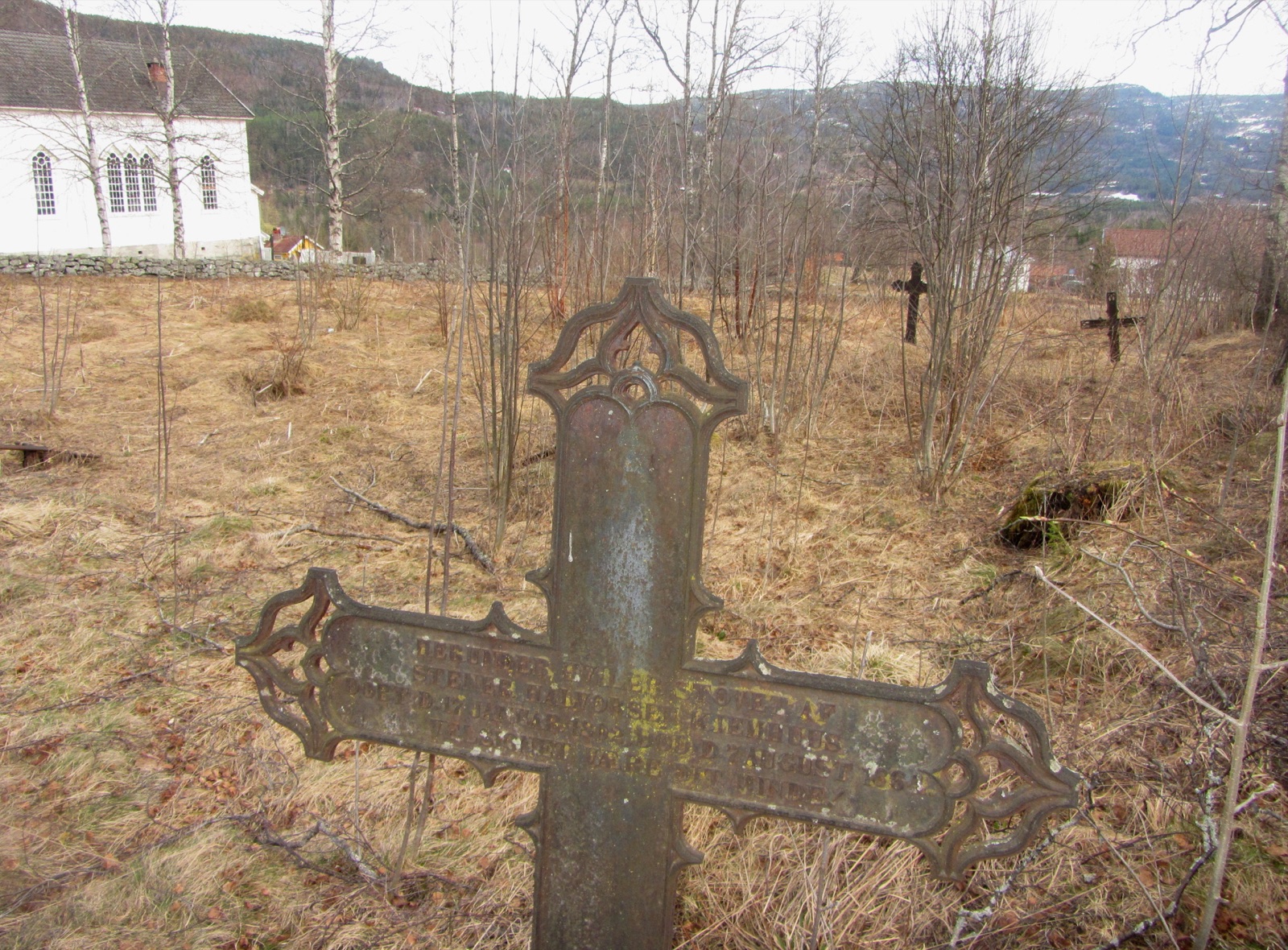
Credit
Photograph by Stig Rune Pedersen, 2014, CC BY-SA 3.0, from lokalhistoriewiki.no.Steinar's life, and his music, are told in full in The Wild Fiddler of Numedal.
Halvor
His son Halvor, born on the farm in 1835, took it over. The census of 1865 finds him there at thirty, unmarried, the owner, with his brother Tollef, a merchant at eighteen, their widowed mother Kari living with them on her keep, and two servants. On December 19, 1868, Halvor married Kjersti Tollefsdatter of Ruud, known, the farm history says, for her beauty.
Halvor had been a peddler in his youth, and by 1875 he was dealing in timber as well as farming. That year's census lists Kjersti, their sons Stener and Tollef, Kari, a farm boy, a maid, and a visitor, Gunder Nilsen, just back from America.
It didn't last. A slump, debts he had guaranteed for others, and his failing health brought heavy losses, the farm history says, and in 1886 he sold Kjemhus to Ole Larsen Gjermundstad. The family moved to Nirigard. Kari died on January 31, 1887, at eighty-three; the burial register still gives her home as Kjemhus. She was buried on February 12.
America
Halvor's sister Helge had gone first. She married Peder Tostensen Lien, of Vestre Lien in Veggli, in 1859, and on June 28, 1880, they reached Rushford, Minnesota, with five children. By October they were at Hawley, and the next spring Peder took a homestead near Rollag, Minnesota. Helge died there in 1884, about fifty, and was buried at Grong in Clay County. Their daughter Margit wrote it all down for the Numedal society's American yearbook in 1922, the year her father died.
In May 1887 Halvor's family left. The parish register lists Halvor, Kjersti and four children leaving Rollag, and the Christiania police protocol records them sailing on May 27 on the Rollo: Halvor, 52; Kjersti, 43; Stener, 18; Tollef; Kari; and Torsten, 3½. By October they were in Minnesota, where their son Peder was born at Dawson. Halvor died soon after: in 1887, his niece Margit wrote, or the next year, by the farm history. Kjersti later moved to North Dakota and lived until 1928.
Only Kristi, Steinar and Kari's eldest, stayed. She married Ingebret Bakke of Landrud and lived to 102. The rest of the old family went to America, the farm history says, and entirely new people came to the farm.
Tollef, Clara Kjemhus's father, carried the farm's name to North Dakota. That's why Carl's grandmother was born a Kjemhus.
Who lived here
born or died at Kjemhus · a pale bar is a life whose start isn’t recorded
The same, as a list, with what puts each of them here
- Steinar Halvorsen Gladheim 1802–1864 · died here; the Kjemhus farm history
- Kari Tollefsdatter Kjøntveit 1803–1887 · died here
- Halvor Steinarsen Kjemhus 1835–1888 · born here; named for it; the Kjemhus farm history
- Steinar Halvorson Kjemhus 1869–1907 · born here; named for it
- Tollef Halvorsen Kjemhus 1871–1963 · born here; named for it; the Kjemhus farm history
- Kari Halvorsdtr Kjemhus 1878–1964 · born here; named for it
- Tosten Kjemhus 1883–1943 · born here; named for it
- Peder Halvorson Kjemhus 1887–1936 · named for it
- Clara Regine Kjemhus 1907–1997 · named for it
The records
- 1835. Ole Knudsen sells Nordre Kjemhus to Stener Halvorsen Glaim for 300 speciedaler; deed and registration June 25. Mortgage book I 13, folios 267–268: folio 267, folio 268.
- 1839–1862. Landrud: bought by Stener at auction, October 9, 1839; passed to his son Tollef June 25, 1862. Title index, p. 113: the page.
- 1864. Stener Halvorsen, farmer, of Kjemhuus, died August 7 and was buried August 13. Veggli klokkerbok II 1, p. 212, no. 4: the page.
- 1865. The census at Kjemhuus nordre: Halvor, 30, owner; his brother Tollef, 18; their mother Kari, 62; two servants. The household.
- 1868. Halvor Stenersen Kjemhuus and Kjersti Tollefsdatter Ruud married, December 19. Rollag ministerialbok I 9, p. 124, no. 9: the page.
- 1875. The census: Halvor, farmer and timber dealer; Kjersti; their sons Stener and Tollef; Kari; a farm boy, a maid and a visitor back from America. The household.
- 1887. Kari, widow, of Kjemhuus, born 1803 at Kjøntvedt in Nore, died January 31 and was buried February 12. Veggli ministerialbok II 1, p. 99: the page.
- 1887. Halvor's household leaves the parish, May 16. Rollag ministerialbok I 11, pp. 224–225: the page.
- 1887. They sail from Christiania on the Rollo, May 27. Christiania police emigration protocol 14, p. 79: the page.
The farm history: Knut Hoff, Rollag bygdebokbygdebok (plural bygdebøker) A Norwegian local history, usually a few volumes per district, going farm by farm through who lived there and when. Compiled from church registers, censuses, probate, tax and court records. The Kjemhus line comes from the ones for Flesberg and Rollag. All the words, vol. 1 (1988), pp. 438–457, at the National Library. Steinar's cross: Sigrid Marie and Håkon Christie, Norges kirker, Buskerud, vol. 1 (1981), Veggli kirke.