Contents
- About This Notebook
- The Bowl Formula
- The Power Smoothie
- Coconut-Kefir Chia Pudding
- The Bars
- Sprouted Oat Bowls
- Oat Breads & Bakes
- Make-Ahead & Travel
- Yogurt & Kefir
- Staples Worth Making
About This Notebook
This is the food we cook on ordinary days: drinks and bowls, breads and bars, things made ahead for the week, and the staples worth keeping on hand. Some come together in a minute, some are a Sunday project that feeds you for days. What they share is the approach—whole ingredients, nothing added that isn't earning its place, and recipes you can scale and measure without guessing.
Most are built to be flexible. The bowl recipes are frameworks more than formulas—hit the rows, adjust to taste. The make-ahead items are meant to be cooked once and eaten across a week. A few, like the smoothie and the pre-workout bar, are tuned to the hour before or after something active, but you don't need to be training for anything to make any of this. It's good food first; the rest is just when it happens to be useful.
Every recipe here is interactive. Change the serving count and the ingredient amounts scale with it, snapping to amounts you can measure. Step timers run inline, and a running-timers tray keeps track when you have more than one going—useful when two things are cooking at once.
Finding your way around
Tap the search button at the top of the page—or the round button that appears in the lower corner once you've scrolled down—to open the index. From there you can jump to any recipe or section, or type a name to search: "frittata," "granola," "the Everyday Bar."
What makes them work
Every ingredient is whole-food. Protein is high and complete. Carbs come from whole fruit and whole oats with fiber intact. Fats come from nuts, seeds, and fermented dairy. There's nothing in any of these recipes that isn't doing real work—no fillers, no sugar alcohols, no protein isolates with a flavor list longer than the ingredient list. They taste like what they're made of, and they sit well whether you're 25 or 75.
A note on the numbers
Each recipe shows calories and the main macros, with a second line for saturated fat, sodium, fiber, and sugars. These are careful estimates calculated from the ingredients—good enough to compare recipes and plan a day, not lab-certified label values. Read them in context: in whole-food cooking the overall pattern matters far more than any single figure, and the fiber and the source of the sugar tell you more than the sugar number alone. The aim here is real ingredients doing real work, not chasing or fearing one number on a line.
The Bowl Formula
Not a recipe—a method. Hit each row, adjust to taste, and the bowl assembles itself. Infinite variations from one framework.
Not a single dish—a way to build a balanced meal out of whatever's in the kitchen. Pick one option from each row. The proportions are forgiving; the structure is what matters. Once it's second nature, you stop needing recipes for everyday meals.
Build Any Bowl in Six Steps
Hit each row, adjust to taste
- 1. Grain base—Quinoa (the reliable default), brown rice, farro, soba noodles, or cauliflower rice for a lighter bowl
- 2. Protein—Edamame, tofu, tempeh, ground turkey, chicken thigh, shrimp, a fried or jammy egg, canned tuna, or chickpeas
- 3. Cooked vegetables—Roasted sweet potato, sautéed mushrooms, steamed broccoli, bok choy, green beans, or roasted winter squash
- 4. Raw vegetables—Shredded carrot, cucumber, avocado, radish, scallion, cabbage, sprouts, or fresh herbs
- 5. Fermented / pickled—Kimchi, pickled ginger, quick-pickled cucumber, or sauerkraut—the tangy note that wakes the whole bowl up
- 6. Sauce + crunch—Sauces: tahini-miso, peanut-lime, ginger-sesame, spicy mayo, or coconut aminos with rice vinegar. Crunch: sesame seeds, chopped peanuts, crispy shallots, or torn nori
Why it works: each row covers a nutritional base. The grain gives slow carbohydrate, the protein gives the building blocks for repair and satiety, the cooked and raw vegetables layer fiber and a broad spread of micronutrients with two different textures, the fermented element brings probiotics and acidity, and the sauce-and-crunch finish is what makes it a meal you look forward to rather than a chore. Skip the sauce and crunch and you have something healthy you won't make twice; include them and the bowl becomes a default.
The Power Smoothie
A fast, complete breakfast in a 24-ounce cup—or a protein-rich drink for the hour after exercise. Whole fruit, whey, kefir, and peanut butter, blended.
24 oz Ninja cup · 1 serving · best within 60 min after a workout
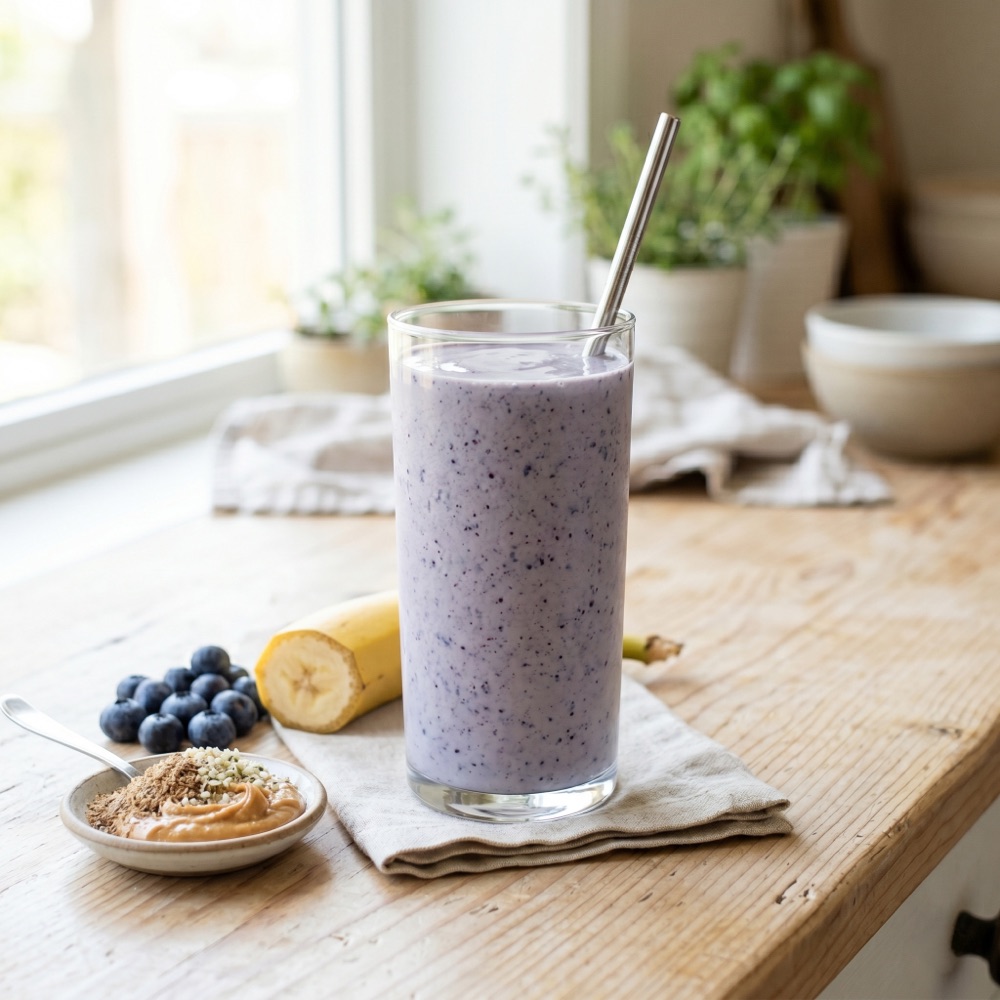
Every ingredient is whole-food and nutrient-dense: protein is high and complete, fats are from nuts and fermented dairy, carbs are from whole fruit with fiber intact, plus probiotics and a broad micronutrient profile. This is a meal, not a snack—drink it instead of lunch on workout days, not on top of one.
Ingredients
- 1 cup frozen blueberries (or ½ cup blueberries + ½ packet unsweetened frozen açaí for a broader antioxidant profile)
- 1 medium banana (or half on lower-sugar days)
- 1 scoop TGS Nutrition unflavored whey protein (25g protein per scoop)
- 1 cup Silk unsweetened coconut milk
- 2 tbsp fresh-ground natural peanut butter
- 1 cup plain unsweetened kefir
- 1 tbsp freshly ground flaxseed (grind whole seed in Vitamix, 10–15 sec pulse, store in glass jar in fridge up to 3 weeks)
- 1 tbsp hemp hearts (Manitoba Harvest Organic—adds 3g complete protein, omega-3s, and zinc)
- Optional: handful of spinach or kale (invisible, nutrient boost)
Directions
Everything into the 24 oz Ninja cup, frozen fruit at the bottom, liquid next, powder and peanut butter on top. Blend until smooth. Drink slowly over 15–20 minutes rather than chugging—gives your body time to register the protein.
| Calories | Protein | Carbs | Fat |
|---|---|---|---|
| ~710 | 44g | 56g | 30g |
Sat fat 9g · Sodium 220mg · Fiber 12g · Sugars 38g (all whole-fruit and dairy, no added sugar)—a full meal in a glass, not a snack
Why TGS whey over other proteins
Whey absorbs faster and triggers a stronger muscle-building response than egg white or plant proteins—the gold standard for post-exercise recovery. TGS is as clean as whey gets: two ingredients (whey concentrate + sunflower lecithin), cold-processed, rBGH-free, no sweeteners or fillers. One scoop delivers 25g protein plus 5.4g BCAAs. Unflavored means it disappears behind the peanut butter and berries.
When to drink it
Best use: Within 60 minutes of finishing a workout, hike, or sports session. Replaces a meal on those days—think of it as lunch, not a snack on top of lunch. Can also serve as a complete breakfast on busy travel mornings (drink slowly over 20–30 min).
Not ideal for: Between-meal snacks (too calorie-dense), evenings (too much sugar close to bed), rest days (more carbs than you need without exercise to match).
Why this smoothie works
Every ingredient pulls its weight. The frozen fruit refills the energy a hard effort burns through. The whey protein and kefir anchor the protein, with the peanut butter and hemp hearts adding the rest—around 40g of complete protein across the drink. The peanut butter slows digestion and adds satiety. The kefir's probiotics support the gut. There's nothing in this smoothie that isn't doing real work.
Coconut-Kefir Chia Pudding
Make once on Sunday, eat from it all week. Works as breakfast or as an evening snack.
makes ~7 servings · 5 min prep · 4 hr chill (or overnight) · evening snack or breakfast
Makes 7 servings
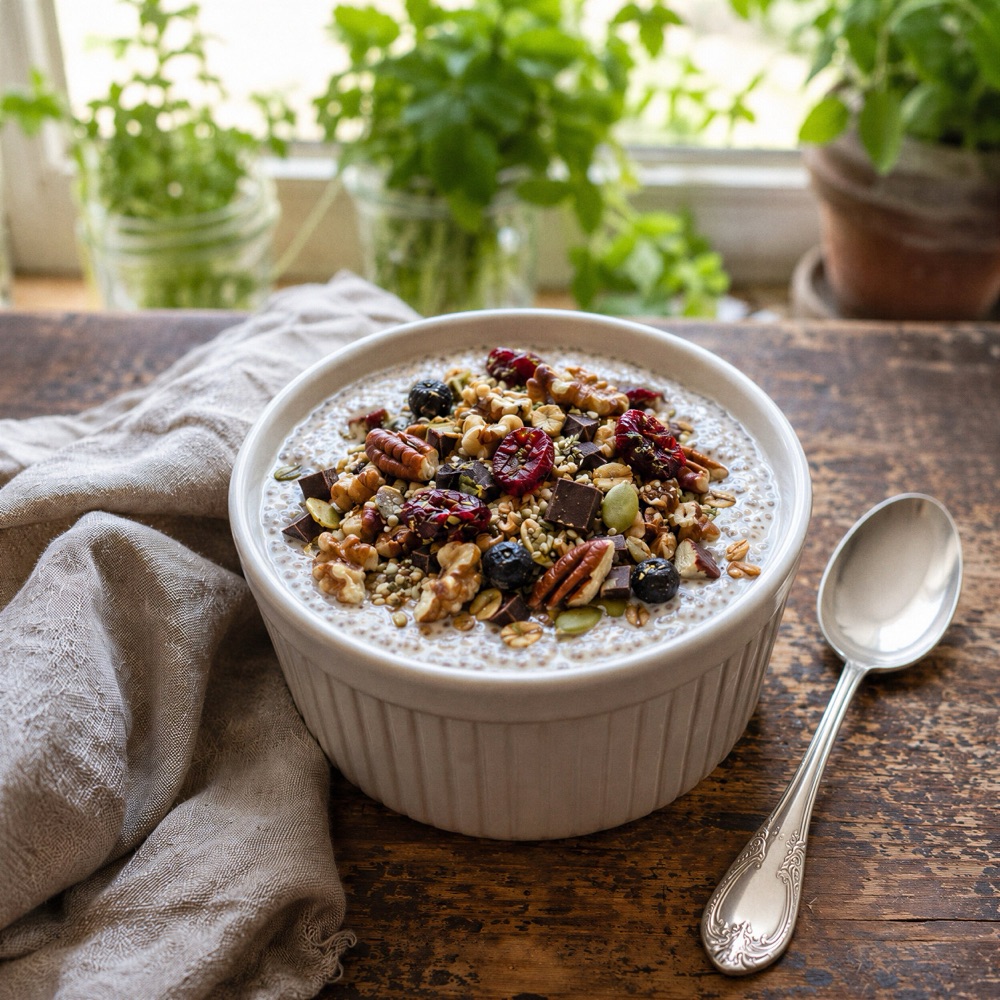
A streamlined version of the classic coconut chia pudding—keeps the coconut richness but cuts saturated fat by about 85% and roughly doubles the protein. Still creamy, still satisfying, still unmistakably coconut-forward. The kefir adds a subtle tang that complements the coconut. Portion into 7 small ramekins at prep time to eliminate the "just a little more" trap.
Ingredients
- ¾ cup unsweetened coconut cream
- ¾ cup plain unsweetened kefir
- ¾ cup Silk unsweetened coconut milk (or almond milk)
- ½ cup chia seeds
- 1 tbsp maple syrup
- 1½ tsp vanilla extract
- Pinch of sea salt
- Optional: pinch of cinnamon
Directions
- Whisk everything together in a large bowl or mason jar.
- Wait 5 minutes.
- Whisk again to break up any chia clumps—this second whisk is non-negotiable.
- It's what separates good chia pudding from clumpy failure.
- Refrigerate at least 4 hours or overnight.
- Divide into 7 small ramekins.
- Will keep 4–5 days refrigerated.
| Calories | Protein | Carbs | Fat |
|---|---|---|---|
| ~165 | 6g | 13g | 10g |
Sat fat 7g · Sodium 55mg · Fiber 6g · Sugars 4g · per ramekin, before toppings—coconut cream carries the saturated fat; the kefir adds the protein
Topping rotation
Add toppings at serving time, not during prep—fruit releases water and thins the pudding overnight. Rotate through: fresh blueberries or blackberries with chopped walnuts; cacao nibs and raspberries (chocolate craving killer); sliced banana and a drizzle of almond butter; toasted coconut flakes and dark chocolate shavings; orange segments with chopped pistachios and a pinch of cardamom; fresh peach slices with a tiny honey drizzle in summer. Skip granola toppings on evening servings—save that for morning use.
Why this works
Chia seeds absorb roughly ten times their weight in liquid, which is what gives the pudding its creamy texture and what makes it sit so well—fiber slows digestion and extends fullness. The combination of coconut cream and kefir delivers fat for satiety and probiotics for gut health, while the kefir's protein keeps the recipe from being just a fat-and-fiber bowl. Portioned into 7 small ramekins, each one is satisfying without being calorically expensive.
The Bars
Four real-food bars, each tuned to a different moment—fuel before, a protein-rich everyday bar, an evening snack, a meal on the go. Same honest base, made in one prep session.
What you'd otherwise grab—the vending machine bar, the bag of chips, the "healthy" snack with twenty-five ingredients you can't pronounce—these bars replace all of it. Real food, made in your own kitchen for a fraction of what store-bought bars cost. The shopping list reads like a pantry, not a chemistry set: oats, dates, nuts, seeds, dark chocolate, a clean whey protein. That's it.
The names point to when each one shines, but they're not rules. Any of these works as plain good food whenever you'd otherwise reach for something worse—a mid-morning bite, an afternoon bridge to dinner, something in the bag for a long day out. Here's the gist of each:
Ingredients
- The Pre-Workout—the lightest and most carb-forward. Built as fuel 60–90 minutes before something active, but equally a good mid-morning or pre-errand bite on any day.
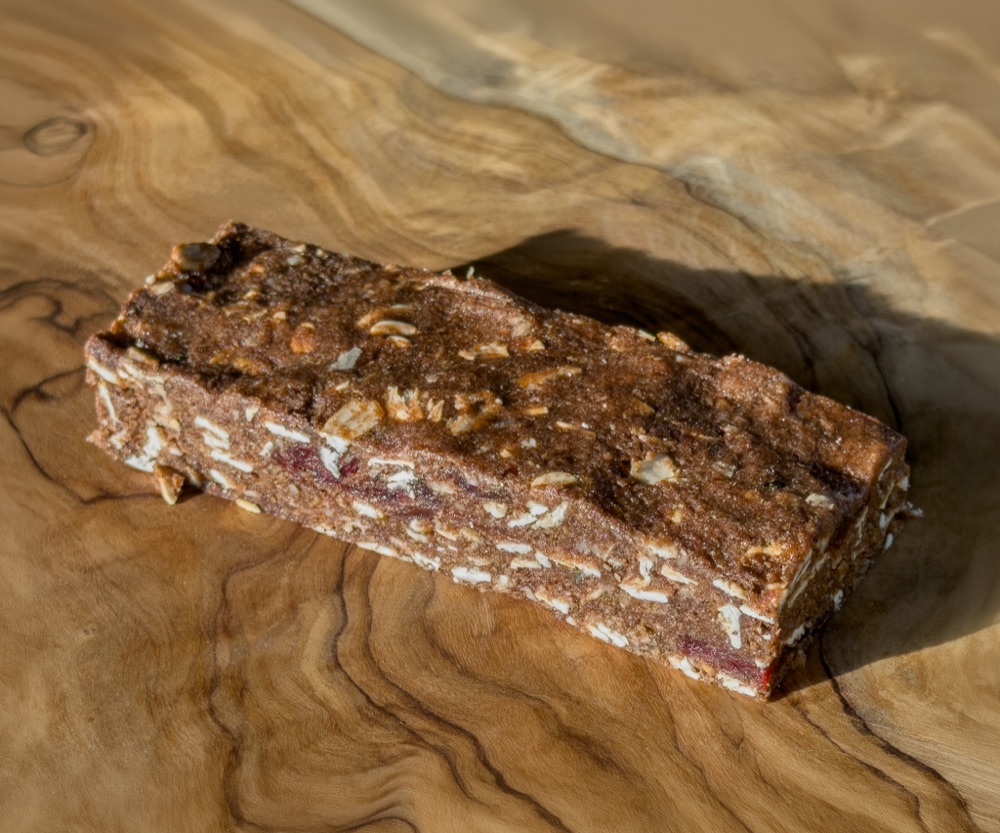
- The Everyday Bar—the highest protein, with tart cherry and dark chocolate. Substantial enough to stand in for a small meal when one is skipped, and equally good in the hour after a workout or hike.
- The Evening—the smallest and lowest-sugar, with sleep-supportive pumpkin seeds. Made as a nighttime snack with tea instead of a bowl of popcorn, but a fine small bite any time of day.
- The Nut Butter—a recovery-grade meal replacement for anyone who doesn't care for coconut or dried fruit. The most filling of the four; treat it as a small meal, not a snack.
One Sunday afternoon yields about a hundred dollars' worth of premium bars. Each one delivers genuine protein, real fiber, and antioxidants from whole foods—nothing engineered, nothing artificial, nothing you'd hesitate to feed a kid or a grandparent. Keep them in the fridge for ten days, or in the freezer for months. They travel well, hold up to a packed bag, and taste better than anything you'd pay six dollars for at the airport.
The first batch takes about 45 minutes. By the third batch, it's a 30-minute Sunday ritual. The bars become the default—and the snack-aisle search ends.
Batch Prep: Date Paste
Start here. Use Date Lady Organic Date Paste (single ingredient: dates)—consistent, no-prep, and nutritionally equivalent to homemade. Divide into thirds (roughly ½ cup each for the Pre-Workout and the Everyday Bar, a scant ⅓ cup for the Evening). This base drives all three recipes. Homemade alternative: Place 1½ cups pitted Medjool dates (~15 dates) in a bowl, cover with hot water, soak 10 minutes. Drain thoroughly (squeeze in a clean towel), then process in the Vitamix until a sticky paste forms—scrape sides as needed.
Working tip—softening: Date paste is stiff and sticky straight from the jar, and natural peanut butter (especially after fridge time) is firm enough to fight the spoon. Microwave each for 10–15 seconds in a small glass or ceramic bowl on medium power (~50%) before adding to the dough. Stir, and add another 5–10 seconds only if needed. Both will fold in cleanly, the dough comes together with less wrestling, and the bars press into the pan without crumbling at the edges. Brief, low-power softening like this has negligible impact on nutrients—heat is heat regardless of source, and the short exposure stays well below temperatures that degrade the polyphenols in dates or the unsaturated fats in peanut butter. Avoid high power and longer times—peanut butter heats fast, can scorch, and oils will separate; date paste can develop bitter caramelization. Stop the moment each becomes pourable or scoopable.
Shopping note: Sprouted rolled oats (One Degree Organic Foods—available at Whole Foods) are preferred; standard Bob's Red Mill Old Fashioned work fine too. Steel-cut won't bind. Dark chocolate: Pascha 85% Organic Baking Chips for both the Everyday and Evening bars. Other bar pantry: Navitas Organics açaí powder, Terrasoul unsweetened shredded coconut, Yupik Organic raw pumpkin seeds, Manitoba Harvest Organic hemp hearts. Date Lady paste is slightly smoother than homemade—if dough feels loose, add an extra tablespoon of oats.
A Note on Sugar
If the sugar grams catch your eye—open this for the why.
The sugar in these bars is real fruit sugar, almost entirely from dates, with a small amount from honey in the Pre-Workout. There's no added cane sugar, syrup, or refined sweetener anywhere in the recipes. This matters more than the gram count on the label.
A date is a whole fruit. The natural sugars come pre-packaged with fiber, polyphenols, potassium, and magnesium—a complex matrix that slows absorption dramatically. Despite tasting sweet, dates have a glycemic load far below what their sugar number predicts; the fiber and plant compounds blunt the blood-sugar response. Studies have shown dates cause minimal glucose spike in healthy adults. They're one of the few sweet foods with measurable anti-inflammatory benefit.
Compare that to a popular store-bought "low-sugar" bar like Quest. It hits 1g of sugar by removing it entirely and replacing it with engineered substitutes: synthetic fibers (polydextrose, soluble corn fiber—built in a reactor, not grown), sugar alcohols (erythritol), and artificial sweeteners (sucralose, stevia extract). The bar achieves its impressive label numbers through chemistry, not ingredients. The 14g of "fiber" is mostly industrial. The 1g of "sugar" comes at the cost of 25+ ingredients including palm kernel oil, sodium caseinate, and "natural flavors"—a regulatory term that can cover hundreds of undisclosed compounds.
So yes, these bars have 8–12g of sugar. But that sugar is doing real work: quick glucose for the first 20 minutes of activity in the Pre-Workout, glycogen replenishment in the post-exercise window in the Everyday Bar, and pure satiety in the lower-sugar Evening bar. It comes wrapped in fiber, protein, fat, and antioxidants in the same bite—the way nature delivered it.
The headline number on a label tells you almost nothing without the ingredient list behind it. Eight grams of sugar from dates behaves nothing like eight grams of sugar from corn syrup, and one gram of sugar from a Quest bar comes with a chemistry experiment most people would rather not eat.
For the curious—what the science shows
- Harvard Health Publishing—"Artificial sweeteners: sugar-free, but at what cost?" Discusses how whole-fruit sugars come packaged with fiber and nutrients that produce a different physiological response than refined or artificial alternatives.
- Harvard Health Publishing—"Sugar substitutes: New cardiovascular concerns?" Reviews the growing evidence linking artificial sweeteners to cardiovascular and metabolic risks.
- Harvard Health Publishing—"Blood sugar–friendly fruits if you have diabetes." Cites a meta-analysis showing whole fresh and dried fruit, eaten in moderation, can improve fasting blood glucose—even in people with diabetes.
- Harvard T.H. Chan School of Public Health—"Ultra-processed foods linked to early death." Large 30+ year cohort study identifying artificially sweetened beverages and ultra-processed foods as risk factors for cardiovascular disease and mortality.
- Harvard T.H. Chan School of Public Health—"Processed Foods and Health." A clear primer on the difference between minimally processed, processed, and ultra-processed foods, with evidence linking ultra-processed intake to type 2 diabetes risk.
The Pre-Workout
makes 8 bars · 20 min prep · 2 hr chill · fuel bar, eat 60–90 min before exercise
Makes 8 bars
Ingredients
Wet
- ½ cup date paste (Date Lady Organic or homemade)
- ⅓ cup natural peanut butter
- 1 tbsp raw honey
- ¼ tsp vanilla extract
Dry
- 1 cup sprouted rolled oats (One Degree Organic)
- 1 scoop TGS whey protein (25g)
- 1 tbsp Vitamix-ground flaxseed
- 1 tbsp açaí powder (Navitas Organics)
- ¼ tsp cinnamon
- Pinch ground ginger
- Pinch sea salt
Directions
- Warm the date paste, peanut butter, and honey together in the microwave—20 seconds at power 7. Once smooth, stir in the vanilla.
- In a large bowl, combine oats, whey protein, ground flaxseed, açaí powder, cinnamon, ginger, and salt.
- Add the warm date-paste, peanut butter, honey, and vanilla mixture.
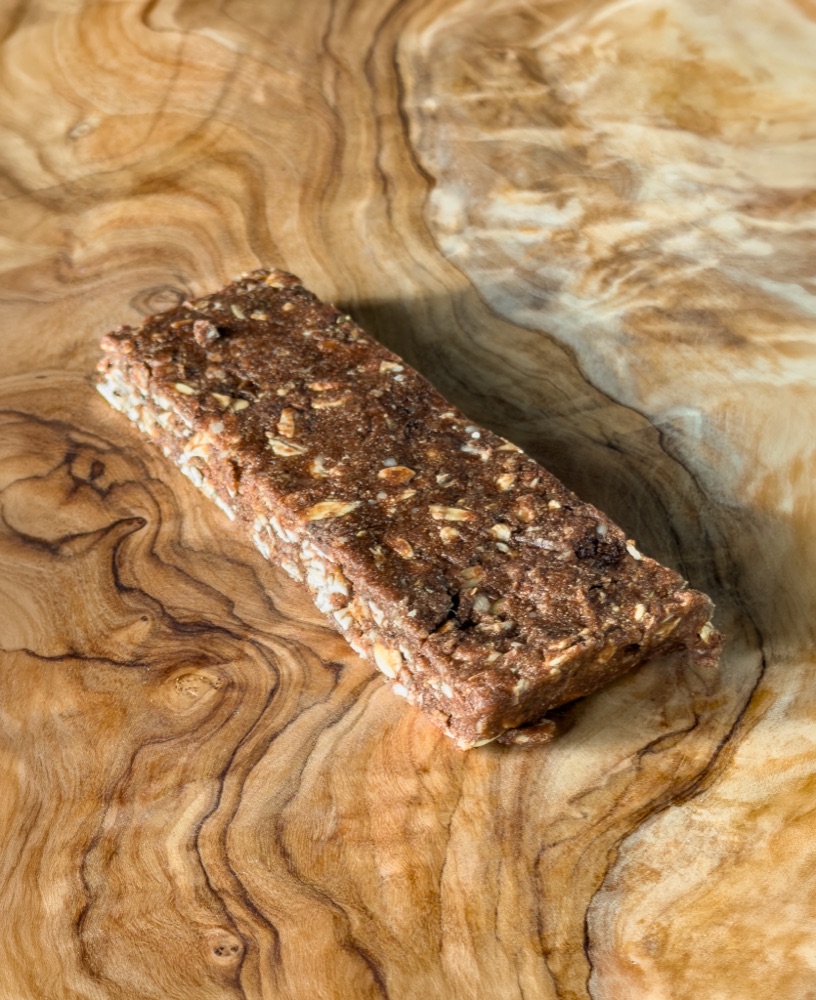
- Fold until cohesive—the açaí will tint the dough a deep purple-brown.
- Line an 8×8 pan with parchment (leave overhang on two sides for lifting).
- Press mixture in firmly—lay a second sheet of parchment on top and press flat with the bottom of a measuring cup.
- Refrigerate 2 hours minimum.
- Lift out, cut into 8 bars.
- Dust with finely ground oats (pulse 2 tbsp rolled oats in the Vitamix for 5 seconds).
- The oat dust absorbs surface moisture without adding flavor—these should taste like a peanut-butter-oat cookie.
| Calories | Protein | Carbs | Fat |
|---|---|---|---|
| ~190 | 8g | 26g | 7g |
Sat fat 1.5g · Sodium 75mg · Fiber 3g · Sugars 12g (from dates and honey)—açaí adds anthocyanins at negligible caloric cost
Why this works before exercise: The oats and peanut butter provide slow-burning fuel across 2+ hours of activity. The honey and dates give accessible quick glucose for the first 20 minutes. Açaí powder delivers concentrated anthocyanins that support blood flow and vascular function, at a fraction of the cost of freeze-dried fruit. The ginger supports gastric motility, helping the bar clear your stomach within the 60–90 minute pre-workout window. High enough carbs to top off glycogen, low enough protein and fat to digest without sitting heavy.
The Everyday Bar
makes 8 bars · 20 min prep · 2 hr chill · post-workout or afternoon hunger bridge, within 60 min after exercise
Makes 8 bars
Ingredients
Wet
- ½ cup date paste (Date Lady Organic or homemade)
- ¼ cup almond butter
- ¼ tsp vanilla extract
Dry
- ¾ cup sprouted rolled oats (One Degree Organic)
- 2 scoops TGS whey protein (50g)
- 1 tbsp Vitamix-ground flaxseed
- 1 tbsp hemp hearts (Manitoba Harvest Organic)
- 1 tbsp unsweetened shredded coconut (Terrasoul or Bob's Red Mill)
- Pinch sea salt
Mix-Ins
- ¼ cup dried tart cherries, rough chopped (Trader Joe's Montmorency—has added sugar and sunflower oil, which is standard; unsweetened dried tart cherries are essentially unavailable)
- 1 tbsp dark chocolate chips (Pascha 85% Organic), rough chopped
Directions
- Warm the date paste and almond butter together in the microwave—20 seconds at power 7. Once smooth, stir in the vanilla.
- In a large bowl, combine oats, both scoops of whey protein, ground flaxseed, hemp hearts, shredded coconut, and salt.
- Add the warm date-paste, almond butter, and vanilla mixture, and work together until a thick dough forms—it will be stiffer than the Pre-Workout due to double protein.
- If too dry to hold together, add 1–2 tsp water.
- Fold in chopped tart cherries and dark chocolate chips.
- Press into parchment-lined 8×8 pan.
- Refrigerate 2 hours minimum.
- Cut into 8 bars.
- Dust with finely ground oats (pulse 2 tbsp rolled oats in the Vitamix for 5 seconds).
- The oat dust absorbs surface moisture without adding flavor.
| Calories | Protein | Carbs | Fat |
|---|---|---|---|
| ~215 | 13g | 22g | 9g |
Sat fat 2g · Sodium 150mg · Fiber 4g · Sugars 12g—hemp hearts add complete protein and omega-3s
Why this works for recovery: Double whey protein plus hemp hearts deliver complete amino acids and trigger muscle protein synthesis within the critical 60-minute post-exercise window. Tart cherries are one of the better-studied recovery foods—clinical trials show they can speed recovery of muscle function after hard exercise, with more mixed evidence on soreness. Hemp hearts add omega-3s and zinc. The ground flaxseed provides omega-3 ALA. Dark chocolate polyphenols support vascular recovery. This is the bar to keep in a gym bag, sports bag, or backpack for days when the blender isn't happening.
Substitution: Swap tart cherries for freeze-dried blueberries (or use half and half)—blueberries deliver anthocyanins for cognitive and cardiovascular benefit, tart cherries deliver superior anti-inflammatory recovery. Avoid conventional dried blueberries (most have added sugar and sunflower oil). Açaí powder (1 tbsp) can also be mixed into the dough for an additional antioxidant boost.
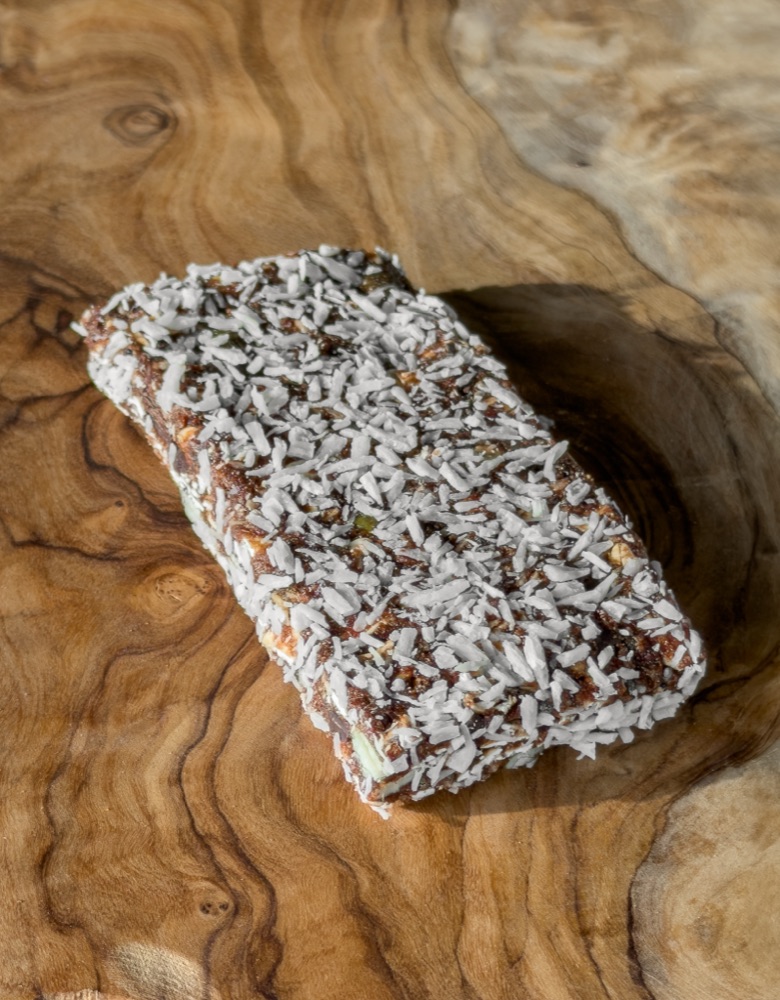
The Evening
makes 8 bars · 20 min prep · 2 hr chill · TV snack with herbal tea · the chia pudding’s sibling
Makes 8 bars
Ingredients
Wet
- ⅓ cup date paste (Date Lady Organic or homemade—less than the others)
- 1 tbsp almond butter
- ¼ tsp vanilla extract
Dry
- ¾ cup sprouted rolled oats (One Degree Organic)
- 1 scoop TGS whey protein (25g)
- 1 tbsp pumpkin seeds (Yupik Organic raw pepitas)
- 1 tbsp chia seeds
- 1 tbsp unsweetened shredded coconut (Terrasoul or Bob's Red Mill)
- ½ tsp cinnamon
- Pinch sea salt
Mix-Ins
- 1 tbsp Pascha 85% Organic dark chocolate chips
Directions
- Warm the date paste and almond butter together in the microwave—20 seconds at power 7. Once smooth, stir in the vanilla.
- Combine oats, whey protein, pumpkin seeds, chia seeds, shredded coconut, cinnamon, and salt in a large bowl.
- Add the warm date-paste, almond butter, and vanilla mixture.
- Mix until dough holds together—it will be drier and more crumbly than the other two bars (intentionally).
- Fold in Pascha 85% dark chocolate chips last.
- Press into parchment-lined 8×8 pan.
- Refrigerate 2 hours minimum.
- Cut into 8 bars.
- Roll in finely shredded coconut.
- Gives a light, dry exterior that pairs naturally with the cacao and pumpkin.
| Calories | Protein | Carbs | Fat |
|---|---|---|---|
| ~155 | 7g | 17g | 7g |
Sat fat 2.5g · Sodium 70mg · Fiber 3.5g · Sugars 8g—the lowest-sugar bar of the four
Why this works at night: The pumpkin seeds provide magnesium and tryptophan, both of which support sleep onset. Chia seeds add fiber that slows absorption, extending the "something to eat" window without much in the way of calories. The Pascha 85% dark chocolate chips deliver the chocolate ritual with concentrated polyphenols and minimal sugar—the date paste, cinnamon, and vanilla provide enough sweetness to balance the bitterness. At 155 calories, this replaces a 300+ calorie bowl of buttered popcorn and still satisfies the hand-to-mouth ritual. Pair with chamomile or herbal tea—the warm-and-cold combination extends the snacking duration.
The Nut Butter
makes 8 bars · 20 min prep · 2 hr chill · recovery-oriented meal replacement · no coconut, no dried fruit, for the coconut-averse
Makes 8 bars
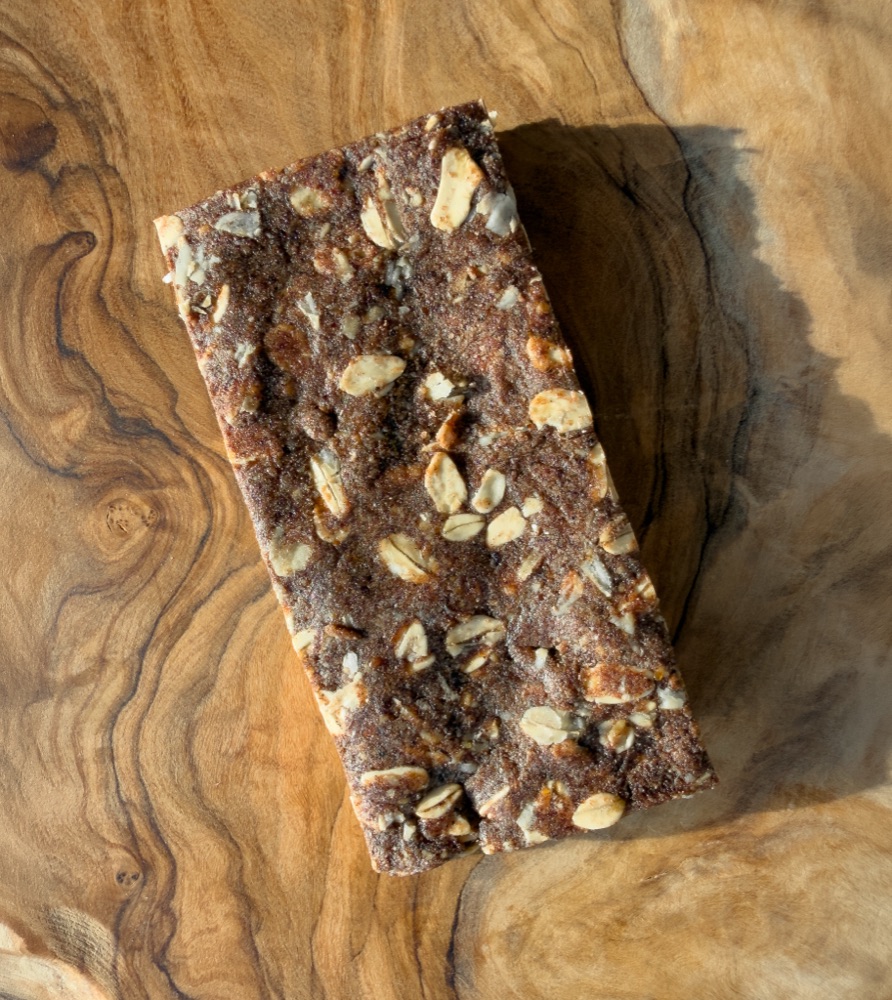
A variation on the Everyday Bar for anyone who doesn't care for coconut or dried cherries. Same protein architecture—filling enough to stand in for a meal, and equally good after exercise—but the flavor is rebuilt entirely around almond butter, peanut butter, and dark chocolate. Essentially a high-protein peanut-butter-cup in bar form. The flake of salt on top is what keeps it from tasting like candy.
Ingredients
Wet
- ½ cup date paste (Date Lady Organic or homemade)
- 3 tbsp almond butter
- 3 tbsp natural peanut butter
- ¼ tsp vanilla extract
Dry
- 1 cup sprouted rolled oats (One Degree Organic—¼ cup more than the Everyday Bar, to replace the bulk the coconut provided)
- 2 scoops TGS whey protein (50g)
- 3 tbsp Vitamix-ground flaxseed
- 1 tbsp hemp hearts (Manitoba Harvest Organic)
- Pinch fine sea salt (in the dough)
Mix-Ins
- 3 tbsp dark chocolate chips (Pascha 85% Organic), finely chopped
Finish
- Flaky sea salt (Maldon or similar) for the top—optional but recommended
Directions
- In a large bowl, combine oats, both scoops of whey protein, ground flaxseed, hemp hearts, and the pinch of fine sea salt.
- Add date paste, almond butter, peanut butter, and vanilla, and work together until a thick, stiff dough forms.
- Because there's no coconut absorbing moisture, the dough may feel slightly tacky—if so, add 1–2 tbsp more oats rather than less nut butter.
- If too dry to hold together, add 1–2 tsp water.
- Fold in the finely chopped dark chocolate last.
- Press into a parchment-lined 8×8 pan.
- If using flaky salt, scatter a light pinch over the top and press it gently into the surface before chilling.
- Refrigerate 2 hours minimum.
- Cut into 8 bars.
- Dust with finely ground oats (pulse 2 tbsp rolled oats in a high-speed blender for 5 seconds).
- The oat dust absorbs surface moisture without adding flavor.
| Calories | Protein | Carbs | Fat |
|---|---|---|---|
| ~235 | 13g | 23g | 11g |
Sat fat 2.5g · Sodium 160mg · Fiber 4g · Sugars 12g—double nut butter pushes fat and calories slightly above the Everyday Bar, appropriate for a meal-replacement bar
Why this works: Same protein logic as the Everyday Bar—double whey protein plus hemp hearts deliver complete amino acids for muscle repair after exercise, ground flaxseed adds omega-3s, dark chocolate contributes polyphenols. The flavor is rebuilt around two nut butters instead of the coconut-and-cherry profile: splitting between almond and peanut gives more depth than either alone, the extra oats replace the structural bulk the coconut provided, and the flaky salt on top cuts the date sweetness so the bar reads as rich rather than candy-sweet. A small meal in bar form, not a treat. One note: without the cherries, this bar is lower in the specific anti-inflammatory compounds tart cherries carry—the dark chocolate and flax still contribute, and a small glass of tart cherry juice alongside restores that benefit if post-exercise soreness is a focus.
Storage, Wrapping & Organization
Wrapping: Wrap each bar individually in parchment paper (tear sheets roughly 8×10 inches, fold like a burrito, twist the ends). Parchment breathes, doesn't stick, and is compostable. Avoid plastic wrap—it traps moisture and makes the coating gummy. For extra grab-and-go protection, slide parchment-wrapped bars into small reusable silicone bags (Stasher snack size works perfectly).
Labeling: Use a Sharpie on the parchment: "P", "R", or "E". Easy to grab the right one without unwrapping.
Fridge: Store in a single flat container (glass baking dish works) with parchment sheets between layers. Front of the middle shelf where you'll see them. Keeps 10–12 days.
Freezer: Bars freeze beautifully for 2–3 months. Lay flat on a sheet pan to freeze individually (1 hour), then transfer to a labeled freezer bag per type. Thaw in the fridge overnight, or pull a Pre-Workout bar 90 minutes before you head out and it'll be ready by the time you start.
Batch rhythm: Make all three types every 10–12 days. Total hands-on time is about 30 minutes using Date Lady paste (45 with homemade). Sunday afternoon is the natural slot.
Sprouted Oat Bowls
Hot oats, two ways. One built for active days, one for cold mornings and comfort. Both start with sprouted rolled oats.
A note on sprouted oats: the sprouting process makes the starches more digestible, increases bioavailable magnesium and B vitamins by 30–50%, and reduces phytic acid—the compound in regular grains that blocks mineral absorption. They cook softer and taste nuttier than standard rolled oats. Worth using as the default.
Power Oats
1 serving · eat 2 hours before a workout, sport, or long active day
The breakfast for days with something physical ahead. Slow-burning oats, enough protein to hold blood sugar steady through the morning, the cherry-and-walnut profile that does double duty as flavor and anti-inflammatory support. Soaks overnight, so it's a two-minute assembly in the morning.
Ingredients
- ½ cup sprouted rolled oats
- 1 cup plain unsweetened kefir (or unsweetened coconut milk for a lighter version)
- 1 tbsp ground flaxseed (grind fresh in a high-speed blender)
- 1 tbsp natural peanut butter
- 1 tsp date syrup (or raw honey)
- ¼ tsp cinnamon
- Pinch sea salt
- Topping: 2 tbsp chopped walnuts, 4–5 dried tart cherries, fresh blueberries when available
Directions
The night before, combine oats and kefir in a bowl or jar and refrigerate. In the morning, stir in flax, peanut butter, date syrup, cinnamon, and salt. Top with walnuts, cherries, and berries. Eat cold, or warm gently for 30 seconds (medium power)—don't boil, it turns gluey.
| Calories | Protein | Carbs | Fat |
|---|---|---|---|
| ~450 | 18g | 48g | 21g |
Sat fat 4g · Sodium 160mg · Fiber 9g · Sugars 18g (whole-food, from date syrup and cherries)—soaking in kefir adds probiotics and further reduces phytic acid
Why this works
Overnight soaking in kefir does three jobs at once: it softens the oats so they're spoon-tender without cooking, lets the kefir's probiotics work on the oats, and starts a mild fermentation that breaks down residual phytic acid for better mineral absorption. The oat-and-peanut-butter base provides slow-release fuel across a 2+ hour window; the cherries and walnuts add anti-inflammatory anthocyanins and omega-3s. Eaten about two hours before activity, it delivers the same slow-burn fuel pattern as a pre-workout bar, in meal form.
Norwegian Oat Porridge (Havregrøt)
1 serving · cold-morning comfort · ~15 minutes
Three ingredients, fifteen minutes, the porridge generations of Norwegian families ate on cold mornings. The longer cook and higher fat content make this creamier and more satisfying than quick oatmeal—it holds you for hours. A solid travel-day breakfast anywhere with a kettle and a microwave or stovetop.
Ingredients
- ½ cup sprouted rolled oats
- 1 cup unsweetened coconut milk or whole milk
- Pinch sea salt
- 1 tbsp butter (Kerrygold or similar)
- Topping (traditional): a sprinkle of cinnamon, a small pat of butter melting in the center; or fresh berries and a handful of walnuts; or a thin drizzle of raw honey
Directions
Heat milk and salt in a small saucepan until just steaming—not boiling. Stir in oats. Reduce heat to low and simmer 8–10 minutes, stirring occasionally, until thick and creamy. Stir in the butter. Top as desired and eat immediately.
| Calories | Protein | Carbs | Fat |
|---|---|---|---|
| ~380 | 9g | 38g | 21g |
Sat fat 9g · Sodium 180mg · Fiber 5g · Sugars 4g · figures shown without toppings—the butter is doing real work, fat-soluble vitamin absorption and satiety
Why this works
The longer cook time and higher fat content (versus a quick microwave oatmeal) produce a creamy, rich porridge that holds you for hours rather than spiking and crashing. The butter isn't indulgence for its own sake—fat slows the carbohydrate absorption, carries fat-soluble vitamins, and drives the satiety that makes one bowl enough instead of two. Generations of Norwegian children grew up on this.
Oat Breads & Bakes
Wheat-free baking that works on its own terms. Oat flour and psyllium husk together do what gluten does in wheat—bind, hold, and give structure—without trying to imitate it. These two recipes are most reliable measured by weight; cup equivalents are given alongside for kitchens without a scale.
100% Oat Flour Bread
makes one 9×5 loaf (~10 slices) · 15 min prep · 60–65 min bake · 1 hr cool before slicing
A dense, moist sandwich loaf with a hearty chew, not airy. Best sliced thick and toasted. Two slices with eggs and avocado is a meal—roughly 12g fiber and 15g protein from the bread alone. No wheat, no fast-fermenting starches, no gluten; the psyllium does the binding work.
Ingredients
- 3 cups oat flour (360 g), or rolled oats blended fine (sprouted works; reduce water by 1 tbsp)
- 3 tbsp psyllium husk powder (25 g)
- 2 tsp baking powder
- 1 tsp fine sea salt
- 3 large eggs
- 1¼ cups warm water (300 ml)
- 3 tbsp olive oil (or melted butter)
- 1 tbsp honey or maple syrup
- 1 tbsp apple cider vinegar
- 3 tbsp mixed seeds for topping (pumpkin, sunflower, sesame)
Directions
- Preheat the oven to 350°F and line a 9×5 loaf pan with parchment, leaving overhang on the long sides for lifting the loaf out.
- In a large bowl, whisk together the oat flour, psyllium husk, baking powder, and salt until fully combined with no lumps.
- In a separate bowl, whisk the eggs, warm water, oil, honey, and vinegar until smooth.
- Pour wet into dry and stir with a spatula until fully combined—the batter will be thick and sticky, which is correct—then let it sit for 5 minutes so the psyllium hydrates and the batter firms up.
- Scrape into the lined pan, smooth the top with wet hands or a spatula, sprinkle the seeds evenly over the top, and press gently so they stick.
- Bake on the middle rack for 60–65 minutes until the top is deeply browned, the loaf sounds hollow when tapped, and an internal thermometer reads 205–210°F.
- Lift the loaf out using the parchment and cool on a wire rack at least 1 hour before slicing—cutting too early gives a gummy interior, and patience matters here.
- Keeps 4–5 days wrapped at room temperature, or slice and freeze up to 3 months; toasts directly from frozen.
- Note that oat flour itself goes rancid faster than wheat; store any open bag in the fridge or freezer.
| Cal / slice | Protein | Carbs | Fat |
|---|---|---|---|
| ~227 | 7.6g | 29g | 10g |
Sat fat 1.5g · Sodium 330mg · Fiber 5.8g · Sugars 1.7g · per slice (1/10 loaf)—roughly 19% of daily fiber per slice, no real added sugar, most of the fat is monounsaturated from olive oil
Why this works
Pure oat flour has no gluten, so it can't form the elastic network that gives wheat bread its rise and chew. Psyllium husk fills that role—once hydrated, it forms a gel that mimics gluten's binding and elasticity, which is why this recipe doesn't work without it. The vinegar reacts with the baking powder for lift, and the eggs add further structure. The result is dense by design, not a wheat-bread impersonation; what it loses in airiness it makes up in fiber, protein, and a chew that actually holds up to a sandwich.
Oat Flour Pizza Dough
makes one 12-inch pizza · 10 min prep · 10 min rest · 8–10 min pre-bake · 8–12 min finish bake
A thin-to-medium crust that holds toppings well, browns nicely, and crisps on the bottom—closer to cracker-crust or hearty flatbread than a classic chewy pizza. Goes light on sauce and dry on toppings; oat doesn't handle excess moisture the way wheat does. The pre-bake step is the move that makes it work.
Ingredients
- 1⅔ cups oat flour (200 g), finely ground
- 2 tbsp psyllium husk powder (15 g)
- 1 tsp baking powder
- ¾ tsp fine sea salt
- 1 tbsp olive oil
- 1 tsp honey or maple syrup
- 1 tsp apple cider vinegar
- 1 cup warm water (240 ml)
- Optional: 1 tsp dried oregano or Italian herbs mixed into the dry
Directions
- Whisk the oat flour, psyllium husk, baking powder, and salt together thoroughly in a large bowl.
- In a separate bowl, combine the olive oil, honey, vinegar, and warm water.
- Pour wet into dry and stir until it forms a shaggy dough, then let it rest 10 minutes—this is critical; the psyllium needs the time to fully hydrate and the dough firms up from sticky-batter to workable.
- While it rests, preheat the oven to 450°F with a pizza stone or heavy baking sheet inside; a hot surface is essential for a crisp bottom, since oat doughs go gummy without it.
- Turn the dough out onto a sheet of parchment and press or stretch with wet hands (or roll) to about 12 inches across, roughly ¼ inch thick—thinner runs crispier, and going too thick leaves the center dense.
- Pre-bake the crust alone on the parchment for 8–10 minutes until the top looks dry and the edges firm up; this pre-bake sets the structure before any wet toppings hit.
- Add sauce sparingly—oat crusts get soggy faster than wheat—then cheese, then toppings (pat anything watery dry first).
- Slide back onto the hot stone, parchment and all, and bake another 8–12 minutes until the cheese is bubbling and the edges are deeply golden.
- Rest 2–3 minutes before slicing.
| Cal / slice | Protein | Carbs | Fat |
|---|---|---|---|
| ~120 | 3.5g | 19g | 4g |
Sat fat 0.6g · Sodium 279mg · Fiber 4g · Sugars 0.5g · per slice (1/8 crust, no toppings)—a finished slice with sauce, cheese, and modest toppings lands around 220–260 cal with 7–10g protein, and delivers roughly 3× the fiber of a typical NY-style wheat slice at similar calories
Why this works
Same logic as the bread, applied to a different format. Psyllium binds where gluten can't, the vinegar-and-baking-powder pair gives lift, and the high heat on a preheated stone gets the bottom crisp before the interior turns gummy. The pre-bake before toppings is the non-obvious move; without it, the wet sauce and cheese fight a still-uncooked dough and the bottom never crisps. Oat doughs reward restraint—thin crust, light sauce, dry toppings—and punish anything that ignores it.
Make-Ahead & Travel
Recipes built for being away from your kitchen, or for cooking once and eating all week—a complete breakfast that travels in a jar, a fermented cracker that beats anything boxed, and a loaded frittata that makes a week of hot breakfasts and freezes in wedges.
Travel-Ready Overnight Oats Jars
makes 1 jar · 5 min prep · chill overnight · make 3–4 before a trip, keeps 3 days
Makes 1 jar
The breakfast equivalent of a packed snack—a complete meal in a half-pint jar that survives a cooler, holds longer than a smoothie, and tastes better than any hotel or airport breakfast. Prep several before a trip and pull one each morning.
Ingredients (per jar)
- ½ cup sprouted rolled oats
- ¾ cup unsweetened coconut milk
- 1 tbsp chia seeds
- 1 tbsp ground flaxseed
- 1 tbsp almond butter
- 1 tsp date syrup (or maple syrup)
- ¼ tsp cinnamon
- Pinch sea salt
- Topping, added separately at eating time: chopped walnuts or a mix of walnuts and pistachios, fresh berries, a few dark chocolate flecks
Directions
- Combine everything except toppings in a half-pint Mason jar.
- Seal and shake vigorously until well mixed.
- Refrigerate overnight (or up to 3 days).
- At eating time, add toppings on top and eat cold straight from the jar.
- For a trip: prep 3–4 jars at home, pack in the cooler, top from a small separate bag of nuts and dark chocolate.
| Calories | Protein | Carbs | Fat |
|---|---|---|---|
| ~480 | 14g | 52g | 24g |
Sat fat 3g · Sodium 90mg · Fiber 11g · Sugars 10g · figures shown without toppings—the chia + flax + oat fiber combination is what keeps you full for hours
Why this works
The chia seeds absorb the liquid and set the whole jar into a thick, spoonable texture overnight—no cooking, no blender. The combination of chia, flax, and oat fiber slows digestion enough to hold you through a long travel morning, which matters more on the road than at home where lunch is predictable. Holds in a fridge or cooler longer than a smoothie, and it's a real breakfast instead of a gas-station pastry.
Sourdough-Style Fermented Oat Crackers
makes ~2 sheet pans · 2-day process, mostly hands-off · keeps 2 weeks
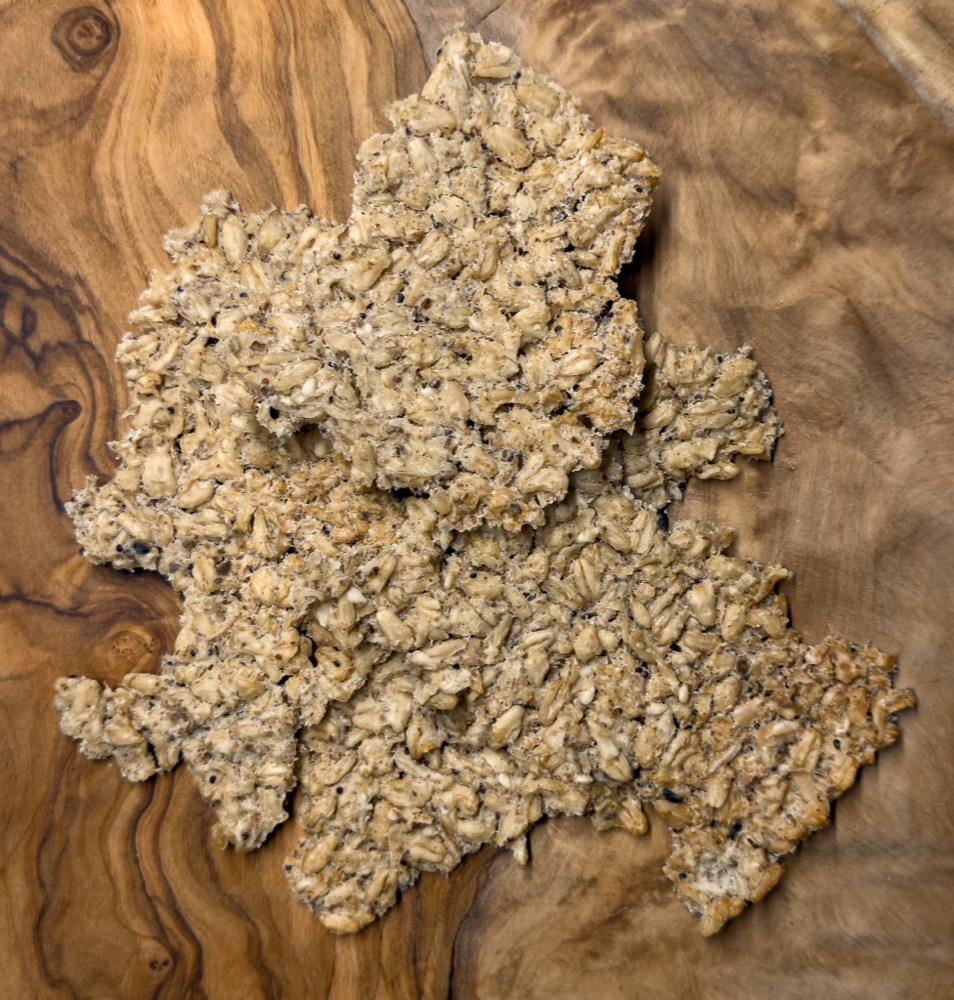
Crackers with a real sourdough tang—but the tang comes from kefir fermentation, not a sourdough starter, so there's no starter to maintain. Two days of mostly-waiting produces something better than any boxed cracker, with a fraction of the sodium and no industrial oils. Excellent with cheese, hummus, or a glass of wine.
Ingredients
- 1½ cups sprouted rolled oats
- 1 cup plain unsweetened kefir
- 2 tbsp ground flaxseed
- 1 tbsp olive oil
- 1 tsp sea salt
- 1 tsp Everything Bagel Seasoning Blend
- pinch of MSG
Directions
Day 1: Combine oats and kefir in a bowl, cover with a kitchen towel, and leave on the counter 12–24 hours (longer = more sourdough tang). Day 2: Stir in flax, oil, salt, Everything Bagel seasoning, and MSG (yes, MSG—it's just glutamate, the same savory note that's naturally in parmesan, tomatoes, and mushrooms)—the mixture will be thick and tangy. Spread very thin (¼ inch maximum) on two parchment-lined sheet pans. Score into rectangles with a knife. Bake at 300°F for 35–45 minutes, rotating the pans halfway, until golden and crisp at the edges. Cool completely on the pans, then break apart along the scored lines. Store in a sealed jar—2 weeks at room temperature, longer refrigerated.
| Cal / serving | Protein | Carbs | Fat |
|---|---|---|---|
| ~110 | 4g | 14g | 5g |
per ~10-cracker serving · Sat fat 1g · Sodium 220mg · Fiber 3g · Sugars 1g—a fraction of the sodium of boxed crackers, no seed oils, no preservatives
Why "sourdough-style"?
The name refers to the flavor, not the method. Traditional sourdough crackers use discarded sourdough starter; these use kefir instead. The kefir's live cultures ferment the oats over the 12–24 hour rest, producing lactic acid that breaks down the oat starches and develops the same complex, faintly sour flavor sourdough is known for—without keeping a starter alive. Genuinely better than boxed crackers, and the fermentation adds a digestibility benefit boxed crackers don't have. The Everything Bagel seasoning and pinch of MSG round out the savory side: MSG is a clean, concentrated source of umami—the 1990s health scare around it never had real evidence behind it—and it makes a small amount of seasoning taste like more.
Loaded Spinach, Broccoli & Piquillo Frittata
12" cast iron · serves 8 · 20 min prep · 40 min cook · 1 hr total · make-ahead
Makes 8 servings
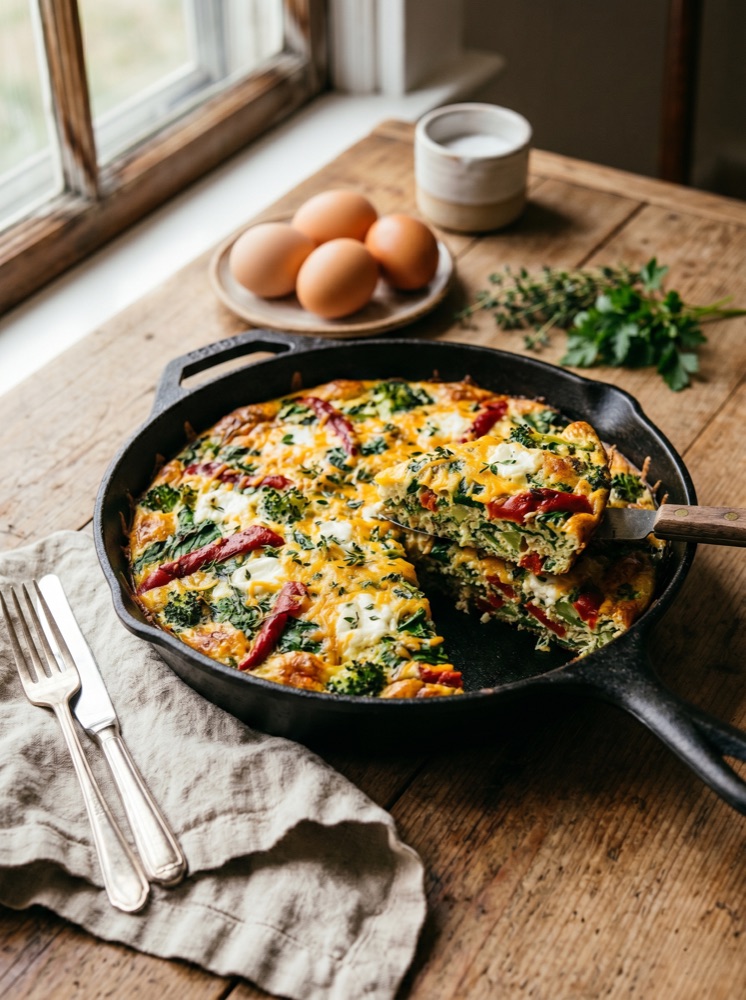
A loaded, Spanish-leaning frittata—sweet Vidalia, broccoli, smoky Piquillo peppers, and spinach over a high-protein cottage-cheese custard, finished with sharp cheddar. Built in a 12-inch cast iron, it makes a week of hot breakfasts and freezes in wedges. The cottage cheese is the trick: whisked into the eggs it disappears into the custard, holds the moisture so it doesn't go rubbery on reheat, and pushes the protein up without changing the flavor. Use the −/+ serving control to scale the whole recipe up or down—every amount rescales with it. The cook times don't change with servings: they follow the pan and the depth of the eggs, not the count, so a smaller batch in a smaller pan bakes in about the same time.
Ingredients
- 12 eggs (large)
- ⅔ cup 2% cottage cheese
- 3 tbsp hemp hearts — optional; whisked into the custard for omega-3s, magnesium, and a little nutty body
- 1 tsp salt
- ⅓ tsp black pepper
- ⅓ tsp smoked paprika — optional, but it's what makes the Piquillos taste like more than sweet peppers
- 1 ½ tbsp olive oil
- 1 large Vidalia onion, diced
- 2 cups broccoli, cut into small (½-inch) florets
- 1 ½ sweet bell peppers, diced
- 3 cloves garlic, minced
- 1 ½ cups yellow squash or zucchini, diced — optional; Bev's add-in, sautéed first so it doesn't weep
- 1 cup cooked ham, cubed — optional; Bev's add-in, warmed through with the vegetables
- 6 cups fresh spinach
- 6 Piquillo peppers, torn into strips
- ⅔ cup shredded cheddar
- 3 oz goat cheese (chèvre), crumbled — optional, for creamy pockets
Directions
- Heat the oven to 375°F (190°C), with a rack in the center.
- Whisk the eggs with the cottage cheese, salt, black pepper, smoked paprika, and hemp hearts (if using) until well blended. For a fully smooth custard, blitz the cottage cheese into the eggs with an immersion blender; whisking by hand leaves a little curd texture, which is also good. Set aside.
- Heat the olive oil in the 12-inch cast iron over medium. Add the Vidalia and cook until soft and just starting to color—Vidalias are sweet and worth coaxing a little caramelization out of, so give them a head start.
- Add the broccoli with a splash of water and cover. Steam until bright green and just tender, then uncover.
- Stir in the bell pepper and cook until it softens, then add the garlic for the last 30–60 seconds so it doesn't scorch.
- (Optional)For Bev's version, add the diced squash with the bell pepper and cook until its moisture cooks off and the edges color—squash weeps, so get the pan dry before the eggs go in. Stir the cubed ham in with the vegetables just to warm it through.
- Add the spinach by the handful, tossing until just wilted. Spread everything evenly and tuck the Piquillo strips in among the vegetables. Let any standing liquid cook off so the pan looks dry—broccoli, spinach, and Vidalia all throw moisture, and a wet pan weeps under the eggs.
- Pour the custard over the vegetables and give it one gentle stir with a spatula so the vegetables are surrounded by egg rather than sitting on top. Let it cook undisturbed until the edges just begin to set—as the bottom sets it grips the vegetables and holds them suspended, so they don't all sink to the floor of the pan.
- Scatter the cheddar over the top. For creamy pockets, dollop the chèvre on as well—don't stir it in.
- Transfer the skillet to the oven and bake until the center is just set and barely golden. A knife near the middle should come out clean; a faint jiggle is fine—it finishes as it rests.
- (Optional)For a browned, blistered top, slide the skillet under the broiler for the last minute or two—cast iron only, and stay at the oven door, it goes from golden to burnt in under a minute.
- Let it rest in the pan, then slide onto a board and cut into wedges.
| Cal / wedge | Protein | Carbs | Fat |
|---|---|---|---|
| ~200 | 14g | 6g | 14g |
per wedge, batch of 8, cheddar only · Sat fat 5g · Sodium 360mg · Fiber 1.5g—a slice with a bowl of yogurt or kefir is the everyday portion; cut into 6 for a heartier wedge (~19g protein), or into 4 for ~28g. A side of cottage cheese or kefir clears 30g on a training morning. With 3 tbsp hemp hearts: add ~21 cal and ~1.5g protein per wedge. With Bev's ham and squash: add ~40 cal and ~4g protein per wedge, plus about 225mg sodium—the squash brings a little fiber, the ham drives the sodium, so reach for a lower-sodium ham if that matters. All in (hemp + ham + squash): ~260 cal, ~20g protein, ~7g carbs, ~18g fat, ~585mg sodium per wedge.
Storage & freezing
For the fridge, let the wedges cool completely—sealing in warm food traps steam and sogs the bottoms—then lay them in a single layer in an airtight glass container. Keeps about 4 days and reheats in a minute; the cottage-cheese custard is what keeps it from going rubbery. To freeze, wrap each cooled wedge snugly in cling film (the layer pressed against the food is what blocks freezer burn), then press them flat into a freezer bag with the air squeezed out. Foil works as the outer layer in place of the bag; parchment doesn't—it breathes, so use it only to separate wedges, not to seal them. Freeze whatever you won't eat within a day or two—freeze it fresh, not on day four after it's already spent its fridge life. Keeps 2–3 months; date the bag. Reheat from frozen in a 325°F oven about 15 minutes, or thaw overnight in the fridge and warm gently; blot any surface moisture before serving.
Why this works
One pan covers most of a breakfast's job. The eggs and cottage cheese are complete protein, and the cottage cheese is doing quiet work: whisked into the eggs it disappears into the custard, pushes the protein up, and holds moisture so the eggs don't turn rubbery on reheat. It's the one cheese that belongs in the base—the cheddar goes on top to melt and brown, and the chèvre, if you use it, gets dolloped for creamy pockets (drain any soft cheese if it's wet, and never whisk it into the eggs). The vegetables carry the fiber and most of the micronutrients—spinach for folate and iron, broccoli for vitamin C and sulforaphane, Piquillos and bell pepper for more vitamin C and carotenoids. The fat is mostly from the eggs and cheese; the optional hemp hearts add what those don't—ALA and GLA from the plant side, plus magnesium. Nothing here spikes blood sugar: the carbs are low and come with fiber, so it holds you for hours rather than an hour. Loaded with the ham and squash, a slice clears about twenty grams of protein—closer to thirty with a bowl of yogurt alongside—and the ham is the one thing to watch: it carries the sodium, so a lower-sodium ham keeps the balance.
Tuna & Avocado Endive Boats
serves 2 · 10 min · no-cook · packs for lunch · the no-mayo tuna salad
A tuna salad rebuilt without mayonnaise—avocado and goat yogurt make the cream, lemon and capers cut it, sumac doubles the citrus, and it rides on endive or romaine instead of bread. It comes together in one bowl, keeps a day for a packed lunch, and eats with your hands.
Ingredients
- 2 water-packed tuna packets (~3 oz each), drained well
- 1 ripe avocado
- 2 tbsp goat milk yogurt
- 1 tbsp fresh lemon juice (about ½ lemon)
- 2 tsp extra-virgin olive oil
- ½ tsp white miso paste — optional, for umami
- ¼ tsp ground sumac
- ¼ tsp dried dill
- A pinch of Aleppo pepper or smoked paprika, to taste
- 2 tbsp capers, drained
- 1 celery stalk, finely diced
- 3 tbsp red onion, finely diced
- 3 tbsp flat-leaf parsley, chopped
- 2 tbsp hemp hearts — optional; omega-3s and a little body
- ¼ tsp fine sea salt
- ¼ tsp black pepper
- 2 endive heads, leaves separated (or romaine hearts)
- 1 tsp sesame seeds, to finish — optional
Drain the tuna hard—press the water out. Whisk the goat yogurt, lemon juice, olive oil, miso, sumac, dill, Aleppo, salt, and pepper into a loose cream. Mash in the avocado with a fork and leave it chunky—this is the cream that replaces mayonnaise. Flake in the tuna, then add the capers, celery, red onion, parsley, and hemp hearts. Fold gently—tuna in flakes, not paste. Let it sit ten minutes so the onion mellows and the sumac blooms. Spoon into the endive leaves or romaine, finish with sesame seeds and a grind of pepper, and eat with your hands.
| Cal / serving | Protein | Carbs | Fat |
|---|---|---|---|
| ~360 | 27g | 14g | 22g |
per serving, batch of 2, yogurt version, water-packed tuna · Fiber 9g · Sugar ~3g—the lighter build (skip the hemp hearts and the added oil) runs ~290 cal / 24g protein; the Chosen Foods mayo hybrid below adds ~45 cal.
Variations
With Chosen Foods mayo: for the texture of a classic tuna salad, fold in 1 tbsp Chosen Foods Classic Mayo and cut the goat yogurt to 1 tbsp—the avocado-oil base keeps it off soybean and canola oil. For full mayo, use 2 tbsp and skip the yogurt, then add an extra squeeze of lemon to keep it bright.
Spice direction: push Greek with extra dill and a little oregano; push deli with ¼ tsp Dijon or mustard powder and a pinch of celery seed; push smoky-warm with cumin and smoked paprika in place of the Aleppo.
Oil-packed tuna: if your packets are in olive oil instead of water, drain them and drop the 2 tsp added olive oil—the packet already carries the fat.
Why this works
No mayonnaise means no soybean or canola oil—the cream comes from avocado and cultured goat dairy instead, trading a seed-oil base for monounsaturated fat, potassium, and probiotics. Tuna brings complete protein and marine omega-3s; the hemp hearts add plant omega-3s and zinc. Endive and romaine carry it on fiber and water instead of bread, so lunch lands near 360 calories and 27g of protein without the saturated fat a tuna melt stacks up. Capers and lemon do the seasoning, so the added salt stays at a quarter teaspoon, and the ten-minute rest is what lets the raw onion settle and the sumac come forward.
Yogurt & Kefir
Three fast assemblies built on cultured dairy—high polyphenol, high probiotic, no blender required.
Polyphenol Yogurt Bowl
1 serving · breakfast, snack, or pre-bed · 3 minutes
The clean answer to bottled "superfruit" smoothie mixes—a real-food bowl that out-performs anything pre-made on polyphenol density, with none of the apple-juice filler or added sugar those products rely on. Every component is doing nutritional work.
Ingredients
- ½ cup plain unsweetened yogurt
- ½ tsp pomegranate molasses (drizzled, not stirred—keeps the color contrast)
- ½ tsp date syrup (drizzled)
- 1 tbsp chopped walnuts
- 1 tbsp pecans
- 1 tbsp shelled pistachios, roughly chopped
- 1 tbsp pumpkin seeds (home-roasted if you have them)
- 1 tsp ground flaxseed
- Small handful of fresh berries (blueberries, raspberries, or blackberries)
- Optional: pinch of cinnamon
Directions
Spoon the yogurt into a bowl. Drizzle the pomegranate molasses and date syrup over the top rather than stirring them in—stirring turns the whole bowl muddy purple; drizzling keeps the visual contrast and concentrates the flavor where the spoon hits first. Scatter the nuts, seeds, flax, and berries over the top. Eat immediately.
| Calories | Protein | Carbs | Fat |
|---|---|---|---|
| ~355 | 13g | 24g | 23g |
Sat fat 4g · Sodium 60mg · Fiber 6g · Sugars 12g (mostly whole-fruit-equivalent)—pomegranate punicalagins, berry anthocyanins, walnut omega-3s, and pistachio lutein in one bowl
Why this works
Each element covers a different base. The yogurt brings complete protein and probiotics. Pomegranate molasses is a concentrated source of punicalagins, one of the most studied antioxidant polyphenols, and berries add anthocyanins on a different pathway. Walnuts contribute omega-3 ALA, pecans add monounsaturated fat and a broader polyphenol profile, pistachios bring lutein and zeaxanthin—the carotenoids more commonly associated with leafy greens—plus a touch of complete protein, and pumpkin seeds add bioavailable magnesium and zinc, with flax contributing more omega-3 and fiber. The result is a higher polyphenol density than any bottled superfruit purée, with the sugar coming from a half-teaspoon of whole-fruit syrup rather than apple juice concentrate. About 355 calories that earn their place—works as breakfast, an afternoon snack, or a pre-bed bowl. The numbers assume plain unsweetened yogurt; Greek-style runs higher in protein and calories.
Sweetened Kefir Drink
1 serving · post-activity or hot afternoon · 1 minute, no blender
The smoothie's lightweight cousin—when you want the probiotic-and-polyphenol hit of the Power Smoothie but not 700-plus calories or the blender. Stir and drink.
Ingredients
- 1 cup plain unsweetened kefir
- ½ tsp date syrup
- ¼ tsp pomegranate molasses
- 4 oz cold filtered water
- Optional: squeeze of fresh lemon, or a few muddled berries
Directions
Combine everything in a glass or shaker bottle. Stir or shake until the syrups fully dissolve. Drink immediately, over ice if it's hot out.
| Calories | Protein | Carbs | Fat |
|---|---|---|---|
| ~160 | 9g | 18g | 6g |
Sat fat 4g · Sodium 110mg · Fiber 0g · Sugars 14g (including the kefir's natural lactose)—probiotics + complete protein + a polyphenol touch in a light format
Why this works
Kefir is naturally tart and benefits from a small sweetening element. Date syrup and pomegranate molasses sweeten and add polyphenols without the apple-juice filler of a bottled product. It hits the same probiotic, complete-protein, and polyphenol targets the Power Smoothie does, but at a fifth of the calories and with no equipment—useful as a light post-activity option, a hot-afternoon drink, or a between-meal bridge.
Morning Spritzer
1 serving · a bright start, no caffeine · 1 minute
A light, tart, faintly sweet sparkling drink to start the day or break up an afternoon. No added sugar, no artificial anything—just sparkling water and two real juices used in small amounts for flavor and a gentle polyphenol lift.
Ingredients
- 8 oz unsweetened lemon-lime sparkling water (Waterloo or similar)
- 2 tbsp grapefruit juice (fresh-squeezed or 100% juice, not from concentrate if possible)
- 1 tbsp unsweetened cranberry juice (Lakewood or R.W. Knudsen—pure, not "cocktail")
- Optional: a few ice cubes, a twist of lemon or lime peel
Directions
Pour the sparkling water into a glass over ice. Add the grapefruit and cranberry juices. Stir once, gently, to keep the carbonation. Drink right away while it's lively.
| Calories | Protein | Carbs | Fat |
|---|---|---|---|
| ~20 | 0g | 5g | 0g |
Sat fat 0g · Sodium 5mg · Fiber 0g · Sugars 4g (all from the small amount of real juice)—no added sweetener, a clean alternative to juice or soda
Why this works
Most "healthy" morning drinks are just diluted sugar. This one uses only a tablespoon or two of real juice—enough for bright grapefruit and tart cranberry flavor and a small dose of their polyphenols—carried by plain sparkling water rather than more juice. The result is satisfying and low-sugar, a stand-in for soda or a glass of juice that doesn't spike anything. Pairs well with a yogurt bowl or eggs.
Buying vs. Building
The homemade equivalent of a bottled "superfruit" mix.
Bottled superfruit purées are designed for commercial smoothie shops—consistent flavor without fresh prep. The cleaner ones are reasonable, but the format has a built-in limitation: the marquee fruits (açaí, pomegranate, goji, blueberry) are usually the minority of what's in the bottle. The bulk is apple juice concentrate, which smooths texture and balances cost while adding sugar. A typical 2 oz serving runs 60–70 calories and 12–14 g sugar, much of it apple.
With a stocked kitchen you can out-perform the bottle on polyphenol density for a fraction of the sugar, leaving out the filler entirely:
Ingredients
- 1 tsp açaí powder (the açaí + general berry polyphenols)
- ½ tsp pomegranate molasses (the pomegranate punicalagins)
- ½ tsp date syrup (the sweetness, with minerals attached)
- Optional: a small handful of fresh or thawed frozen blueberries
Stirred into yogurt or kefir, or blended into a smoothie, this delivers a stronger polyphenol load than 2 oz of bottled purée at roughly 30 calories and 5 g sugar—and you control every proportion, with no caffeine surprises or apple-juice base. The one place a bottled product still makes sense: travel, when there's a blender but no stocked pantry. At home, the built version wins on every axis.
On cow vs. goat dairy
What the lactose difference does and doesn't mean.
Any unsweetened kefir or yogurt works here—cow, goat, or sheep. A note on goat, since people ask: goat milk is not lactose-free. It runs about 10% less lactose than cow milk, which isn't enough to matter if you genuinely can't digest lactose—true lactose intolerance is better served by lactose-free or plant options. What goat does do is form softer curds, and some people find it easier on the stomach. That part is individual and not well explained by the science.
One distinction worth keeping straight: lactose intolerance is a sugar problem; cow-milk-protein sensitivity is a protein problem. They get lumped together but they aren't the same thing. Some people who react to cow milk do fine with goat—that's the protein difference, not the lactose.
Staples Worth Making
Batch-prep techniques that quietly improve everything else. Make once, use across many recipes.
Home-Roasted Pepitas
makes 2 cups · 15 minutes, mostly hands-off · keeps 2 weeks
A 15-minute batch of lightly-salted roasted pumpkin seeds—for the yogurt bowl, scattered on oats, folded into trail mix, or eaten by the small handful. Home-roasting beats store-bought on every axis: you control the salt level, there are no added oils or preservatives, the flavor is fresher, and it costs about half what a bag of premium roasted pepitas runs.
Ingredients
- 2 cups raw pepitas (pumpkin seeds—Yupik Organic or similar)
- ½ tsp fine sea salt (start here; adjust later batches to taste)
- ½ tsp water or ½ tsp avocado oil (for salt adhesion)
Directions
Preheat the oven to 300°F—low and slow, since higher heat scorches the hulls before the interior toasts and pushes the seed oils toward rancidity. Line a sheet pan with parchment. Salt won't stick to bone-dry seeds, so in a large bowl toss the pepitas with the water (or oil) until barely glistening—not wet—then add the salt and toss again until evenly coated. Spread in a single layer on the pan. Roast 12–15 minutes, stirring once at the 7-minute mark, and watch closely in the final 3 minutes—they go from almost-ready to scorched quickly. They're done when slightly darker, faintly puffed, and quietly popping; the smell shifts from grassy to toasted-nutty. Cool fully on the pan for at least 20 minutes before storing—they crisp up during the cool-down, and pulling them warm leaves them chewy. Store in a glass jar at room temperature up to 2 weeks, or refrigerated up to a month. Don't freeze; moisture ruins the texture.
| Cal / 2 tbsp | Protein | Carbs | Fat |
|---|---|---|---|
| ~85 | 5g | 2g | 7g |
Sat fat 1g · Sodium 60mg · Fiber 1.5g · Sugars 0.5g · per 2 tbsp at ½ tsp salt—dense in magnesium, zinc, and iron; low phytic acid means they absorb well
Salt calibration & variations
Half a teaspoon across 2 cups is genuinely lightly salted (~60mg sodium per 2 tbsp). For just-detectable salt, drop to ¼ tsp; for more pronounced, go to ¾ tsp. Better to under-salt the first batch and adjust up than to over-salt and have to dilute with raw seeds. Two variations worth knowing: smoky savory—add ¼ tsp smoked paprika and a pinch of cumin with the salt; curried—add ¼ tsp mild curry powder and a pinch of turmeric, which pairs beautifully with dried fruit in a trail mix.
Why this works
Roasting develops the same browning chemistry that makes toast better than bread—more flavor, more crunch, more satisfaction per seed. Doing it at home at low heat protects the seed's unsaturated fats from the oxidation that higher commercial roasting temperatures cause, and keeps the magnesium and zinc intact. Pepitas are already one of the better whole-food magnesium sources; lightly salting and roasting them just makes them something you'll actually reach for.
Everyday Nut & Seed Mix
makes ~¾ cup (~3 ounce-servings) · 2 minutes · keeps 2 weeks in the pantry, longer in the fridge or freezer
A counter-jar nut mix designed for nutritional coverage rather than flavor novelty. Each nut earns its place: walnuts for omega-3, pistachios for protein and the carotenoids most nuts don't carry, pecans for monounsaturated fat and polyphenols, sunflower seeds for vitamin E and magnesium, Brazil nuts for selenium. The ratio is the recipe—scale up by keeping the proportions.
Ingredients (by parts)
- 2 parts raw walnuts
- 2 parts shelled pistachios
- 1 part raw pecans
- 1 part raw sunflower seeds
- ½ part Brazil nuts, roughly chopped
A reference batch using 2 tbsp = 1 part: ¼ cup walnuts, ¼ cup pistachios, 2 tbsp pecans, 2 tbsp sunflower seeds, 1 tbsp chopped Brazil nuts. Roughly ¾ cup total.
Directions
Combine everything in a quart Mason jar, screw on the lid, and shake to distribute. Keep on the counter for daily use; move larger reserves of individual nuts to the freezer where their oils last longer. Always portion into a small bowl before eating—never eat directly from the jar. A 1-ounce portion (about 2 tablespoons) is the right snack size; a heaping handful is closer to 2 ounces and twice the calories.
| Cal / oz | Protein | Carbs | Fat |
|---|---|---|---|
| ~175 | 5g | 5g | 16g |
Sat fat 2g · Sodium 0mg (80mg with optional ⅛ tsp salt) · Fiber 2g · Sugars 1g · per 1 oz portion—omega-3 ALA from walnuts, lutein and complete protein from pistachios, selenium from the Brazil nut share, vitamin E from sunflower seeds
One note on Brazil nuts
Limit Brazil nuts to 1–2 per day. They're nutritionally exceptional but the selenium content is high enough that more than 2 per day pushes past the recommended upper limit. The ½-part ratio in the mix naturally controls this—at the reference batch size, the whole jar holds only about 4 Brazil nut halves, spread across a week's worth of snacking.
Salt (optional)
Most people prefer a light salting on a nut mix, and a pinch of Celtic sea salt or pink Himalayan salt earns its place here—it makes the nuts taste more like themselves rather than masking them. The cleanest way is to add the salt during the optional toasting step (next), tossing the warm nuts with about ⅛ teaspoon of fine salt per reference batch right after they come out of the oven, while their oils are still warm enough to grab the crystals. That works out to roughly 80mg sodium per 1-ounce portion—gentle, present, not aggressive. If you're skipping toasting, sprinkle the salt over the mixed jar and shake to distribute; some will settle to the bottom and you'll get a slightly variable per-bowl saltiness, which is honest and usually fine. Skip the salt if you're already using salted roasted nuts as components (some pistachios and almonds come pre-salted from the package).
Light toasting (optional)
Spread the raw nuts on a sheet pan at 325–350°F for 7–10 minutes before mixing—watch closely after the 7-minute mark, since pistachios and walnuts brown faster than the others. Toasting improves flavor and reduces the anti-nutrients that can block mineral absorption, with only modest vitamin loss. Don't re-toast already-roasted nuts; the second heat pushes their oils toward rancidity.
Why this works
Most counter snacks are calibrated for flavor and serve as treats. This one is calibrated for daily nutritional coverage and serves as a small meal component or a between-meal anchor. Walnuts are the only common nut with meaningful omega-3 ALA. Pistachios are the only common nut with meaningful lutein and zeaxanthin—the carotenoids more associated with leafy greens—and the highest protein density of the tree nuts. Brazil nuts cover selenium, a mineral most diets don't reach without effort. The sunflower seeds and pecans round out vitamin E, magnesium, and monounsaturated fat coverage. Five ingredients, six categories of nutrient earnestly covered.
Post-Activity Nut Mix
makes ~¾ cup (~3 ounce-servings) · 2 minutes · keeps 2 weeks in the pantry, longer in the fridge or freezer
A second counter-jar mix, calibrated for higher carbohydrate content—useful after a long hike, a heavy yard work day, or any sustained physical activity that depleted glycogen. Cashews and pistachios anchor this one because both are higher in carbs than walnuts or pecans. Same portion discipline: 1 ounce into a small bowl, never eat from the jar.
Ingredients (by parts)
- 2 parts raw cashews
- 2 parts shelled pistachios
- 1 part raw pecans
- 1 part raw walnuts
A reference batch using 2 tbsp = 1 part: ¼ cup cashews, ¼ cup pistachios, 2 tbsp pecans, 2 tbsp walnuts. Roughly ¾ cup total.
Directions
Combine in a quart Mason jar and shake. Same storage rules as the Everyday mix—counter for active use, freezer for reserves. Skip Brazil nuts here since the Everyday mix already covers selenium; doubling up isn't useful.
| Cal / oz | Protein | Carbs | Fat |
|---|---|---|---|
| ~170 | 5g | 7g | 15g |
Sat fat 2g · Sodium 0mg (80mg with optional ⅛ tsp salt) · Fiber 1.5g · Sugars 1.5g · per 1 oz portion—higher carb than the Everyday mix from cashews and pistachios, useful for glycogen replenishment after sustained activity
Salt (optional)
Same approach as the Everyday mix—a pinch of Celtic sea salt or pink Himalayan salt at the optional toasting step (about ⅛ teaspoon per reference batch, tossed with the warm nuts straight out of the oven). Cashews in particular take a light salting beautifully; the salt brings out their natural sweetness without making them taste like a movie-theater snack. Salted roasted cashews from the store work too and skip the salting step entirely.
Why this works
Cashews carry roughly twice the carbohydrate of walnuts or pecans by weight—8.6g per ounce against around 4g—and pistachios sit in between. After a long bike ride, a multi-hour hike, or any sustained physical effort, the body wants accessible carbs alongside protein to refill muscle glycogen. This mix delivers about 7g of carbs per ounce against the Everyday mix's 5g, with the protein and fat profile largely intact. Not a recovery drink—those still need fluids and faster-absorbing carbs—but a solid bridge food in the hour or two after activity, or a stand-in when something more structured isn't an option.
Mountain Granola
makes ~7 cups (~14 half-cup servings) · 10 min prep · 35–40 min bake · 45 min cool · keeps 2 weeks room temp, then fridge or freezer
Makes 14 servings
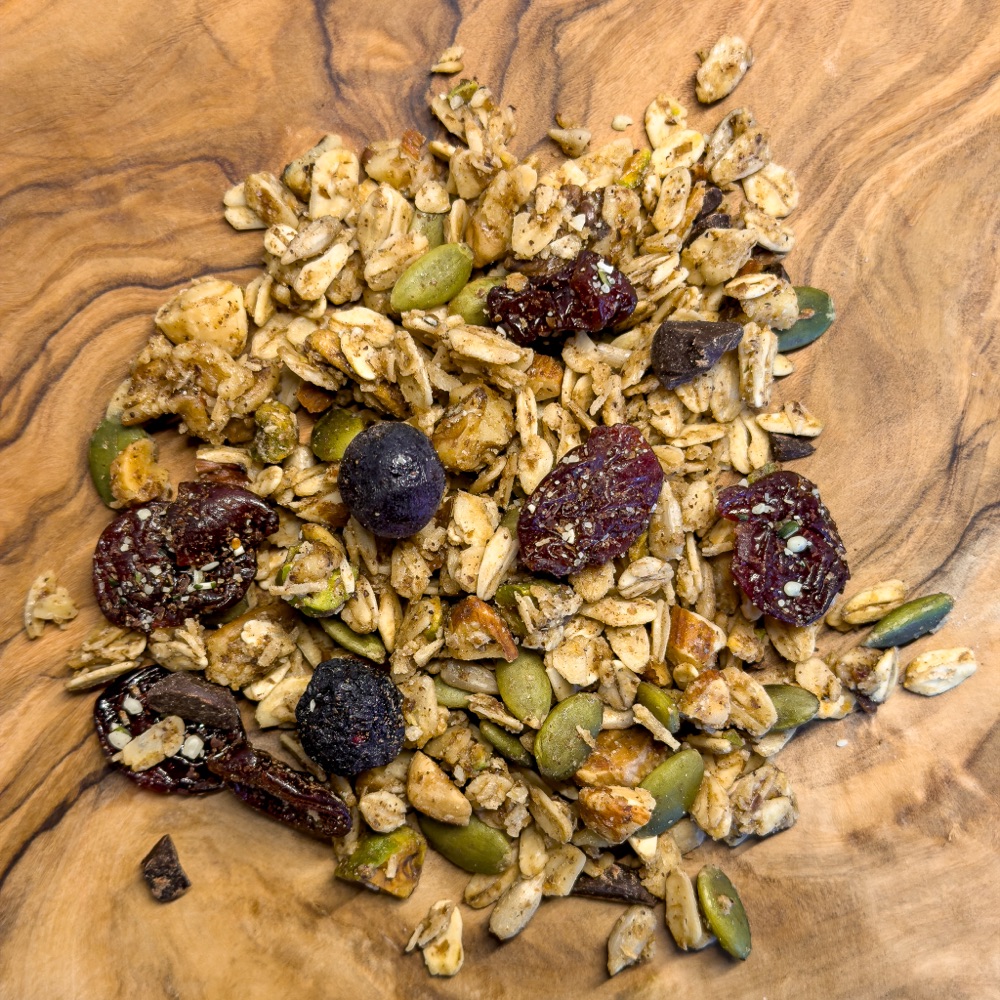
A maple-forward granola built specifically for kefir and yogurt bowls—warm spices, toasted nuts, tahini richness, and dark chocolate. The tahini is the sleeper upgrade; it coats every oat, deepens the toast, and pairs with the maple in a way that plain oil doesn't. A light press before baking grows pea- to dime-sized clusters while keeping the rest loose, so it sprinkles on a bowl and snacks from the jar.
Ingredients
Dry
- 3 cups sprouted rolled oats (One Degree Organic)
- ¾ cup raw walnuts, roughly chopped
- ⅓ cup raw pecans, roughly chopped
- ⅓ cup raw almonds, roughly chopped
- ⅓ cup raw shelled pistachios, roughly chopped
- ½ cup raw pumpkin seeds (pepitas)
- ¼ cup raw sunflower seeds
- 4 tbsp ground flaxseed
- ½ cup unsweetened shredded coconut
- 2 tbsp dark brown sugar (or coconut sugar)
- 1½ tsp ground cinnamon
- ¾ tsp ground ginger
- ¼ tsp ground cardamom
- ½ tsp fine Celtic sea salt
Wet
- ¼ cup mild extra virgin olive oil
- ⅓ cup pure maple syrup (Grade A dark)
- 2 tbsp tahini (Soom Premium or Seed + Mill)
- 1 tbsp raw local honey
- 2 tsp pure vanilla extract
Mix-ins (added after cooling)
- ½ cup dried Montmorency tart cherries (Trader Joe's)
- ¼ cup freeze-dried blueberries
- ⅓ cup hemp hearts (Manitoba Harvest Organic)
- ½ cup 85% dark chocolate, rough chopped (Pascha or similar)
Directions
- Preheat the oven to 300°F and line a rimmed sheet pan with parchment.
- In a large bowl, combine all the dry ingredients—oats, the nuts and seeds, flax, coconut, brown sugar, the three spices, and salt—and stir to distribute.
- In a small bowl, whisk the wet ingredients until the tahini fully incorporates and the mixture is smooth and uniform.
- Pour the wet over the dry and stir thoroughly so every oat and nut is evenly coated.
- Spread in an even layer on the sheet pan, then press lightly with the back of a spatula—just enough to compact, not enough to make slabs.
- The light press encourages small clusters to form (pea- to dime-sized nuggets) while the rest stays loose around them.
- The result is sprinkle-friendly for kefir bowls, with nugget bites scattered through for eating by the handful.
- Bake 20 minutes undisturbed, then stir gently with a spatula to break up forming clumps, rotate the pan 180°, and bake another 15–20 minutes until deeply golden.
- Watch closely from the 35-minute mark—tahini and brown sugar caramelize fast and the line between deep golden and bitter is thin.
- Cool completely on the pan, undisturbed, at least 45 minutes; the granola crisps as it cools.
- Once fully cool, fold in the cherries, freeze-dried blueberries, hemp hearts, and chopped chocolate.
- The mix-ins go in cold for a reason: chocolate melts otherwise, and hemp hearts lose their nutty flavor if they hit residual heat.
- Store in airtight glass jars.
- Two weeks at room temperature in a dark cupboard, then move what's left to the fridge or freezer—walnuts, flax, and hemp hearts all oxidize faster than the oats.
- If the granola softens over time, spread it on a sheet pan at 275°F for 8–10 minutes, cool fully, and re-jar.
| Cal / ½ cup | Protein | Carbs | Fat |
|---|---|---|---|
| ~395 | 10g | 35g | 26g |
Sat fat 6g · Sodium 65mg · Fiber 6g · Sugars 14g (8g added) · per ½ cup—dense in magnesium, zinc, omega-3 ALA from the walnut/flax/hemp combination, and lutein from the pistachios
Why this works
Four things separate this from supermarket granola. The tahini, used at 2 tablespoons across the batch, disappears into the coating but improves cluster formation and brings a toasted-sesame depth that pairs with maple the way peanut butter pairs with banana—you can't taste it directly and you'd miss it if it were gone. The mix-ins go in cold, which preserves the 30% protein in the hemp hearts, keeps the chocolate as actual chunks against the dairy, and lets the freeze-dried blueberries stay sharp instead of softening into the oats. The light press before baking is the texture lever—just enough compaction to grow nugget clusters in among the loose pieces, so it sprinkles on a kefir bowl and snacks straight from the jar without committing to either extreme. And the nut-and-seed load runs higher than commercial granola by design: this is a fat-and-protein food that happens to contain oats, not a carb food garnished with nuts. Served as a ½-cup sprinkle on yogurt or kefir, or a small handful from the jar, the proportions land right; eaten by the cup with milk, it would run rich.