Go back fourteen generations and anyone has thousands of ancestors. This page follows one line of them because the records do. Norway’s farm histories go farm by farm, owner by owner, and these people owned land, so deeds, court books and probate turn them up in every generation back to a deed of 1580. No other line in the family is on paper that far back.
It isn’t the Amoth name. The line runs from Carl’s father, Pete, through Pete’s mother, Clara Kjemhus, and back through her father’s fathers. The Amoths came from Trøgstad, and their story starts with Carl G. Amoth.
Carl’s book on the line and the valley, The Wild Fiddler of Numedal, is here as a draft.
The family tree
Starting from Clara Kjemhus, the last Kjemhus before the line joins the Amoths. Click anyone for a summary.
The chart needs JavaScript. The line is listed below.
The ancestors, generation by generation
Each generation’s record, then its story, from the Norwegian farm histories (bygdebøkerbygdebok (plural bygdebøker) A Norwegian local history, usually a few volumes per district, going farm by farm through who lived there and when. Compiled from church registers, censuses, probate, tax and court records. The Kjemhus line comes from the ones for Flesberg and Rollag. All the words), parish registers, court books and censuses, and for the last four generations, family records. Each farm has its own page, with a map.
Sources: Norwegian bygdebøker (farm histories), Haagen Krog Steffens (1912), parish records, census records.
Sjurd Sevatsen Gjellerud & Gro Amundsdatter LivlandGeneration 0 · c. 1460–1537 · Speculative›
Born Norderhov, Buskerud, Norway · Died Flesberg, Buskerud, Norway
From MyHeritage and Geni.com—not confirmed in Bygdebøker. Patronymicpatronymic A second name made from the father's first name: -sen for a son, -datter for a daughter. Tollef Halvorsen was Tollef, son of Halvor; Karen Torkildsdatter was Karen, daughter of Torkild. It changed every generation, which is why Norwegian lines are traced by farm as much as by name. All the words 'Sjurdsen' in son Sevat's name is consistent with father named Sjurd. Gjellerud farm connection reappears when great-granddaughter Margit marries Olav Gudbrandson Gjellerud c.1600.
Speculative—in online trees and nowhere else
Gro (c. 1460–1542): born Flesberg, Buskerud, Norway · died Flesberg, Buskerud, Norway
Gro: From MyHeritage and Geni.com—not confirmed in Bygdebøker. Maiden name 'Amundsdatter Livland' links to Livland farm in Flesberg, a farm that appears in later Bygdebok records.
Gro: Speculative—in online trees and nowhere else
Children: Sevat
This couple appears on MyHeritage and Geni.com as the parents of Sevat Sjurdsen, but they are not confirmed in any Bygdebok. The Gjellerud Bygdebok traces Gjellerud’s ownership to Gisle Bentson, then Olav Eivindson (c. 1560), then Gudbrand Olson (c. 1591)—no Sjurd appears in the chain. The Livland connection is suggestive: Margit Høljesdotter’s daughter Jårån later married into Livland, and Gro’s maiden name links to the same farm. But suggestive is not documented.
The patronymic “Sjurdsen” in the son Sevat’s name is consistent with a father named Sjurd. That is the strongest evidence, and it is circumstantial. Until a Bygdebok or church record places Sjurd at Gjellerud or anywhere else, this generation remains the line’s unverified origin.
Sources: MyHeritage, Geni.com. Not confirmed in the bygdebøker; the Gjellerud Bygdebok does not mention him.
Sevat Sjurdsen & HelgesdatterGeneration 1 · c. 1495–c. 1564 · Unverified›
Born Lande farm, Flesberg, Norway
Being researched. His son’s name, Hølje Sevatson, says his father was called Sevat; the rest is not yet settled.
Unverified—being researched
Helgesdatter (c. 1495): born Svene, Flesberg, Norway
Helgesdatter: Name from FamilySearch (GD75-PW2)—not confirmed in Bygdebøker. Zero sources listed.
Helgesdatter: Speculative—in online trees and nowhere else
Children: Hølje
Sevat is being researched. What’s known of him comes from his son’s name: the 1580 deed calls Hølje “Hølje Sevatson,” Sevat’s son. It doesn’t say which Sevat, where he lived, or who his wife was. Sigurd Vinger’s Flesberg-boka suggests he may have been Sevat Sigurdson, whose wife seems to have been close kin of the Lande and Livland families, and offers it as a possibility. The birth around 1495 and the Lande birthplace in his record are older estimates; no source for either has been found yet.
His wife’s name appears on FamilySearch as “Helgesdatter” from Svene in Flesberg, but this has zero listed sources and no Bygdebok confirmation.
Sources: the 1580 deed, for his name; Flesberg-boka, vol. IV, p. 400 ff., and vol. II, p. 180 ff., for the suggestion, as Sigurd Vinger cites them. Wife from FamilySearch (GD75-PW2), not confirmed in the bygdebøker.
Hølje SevatsonGeneration 2 · c. 1540–c. 1612 · Wife unverified›
Born Lande, Flesberg, Norway · Also known as Helje Sevatson · Farmer · Died Lehøvd, Flesberg, Norway
Bought a third of deserted Western Lehøvd in 1580 for 3 dalerdaler The silver money Norway counted in before the krone of 1875: the riksdaler, and from 1816 the speciedaler. In the 1830s a farm in Veggli sold for a few hundred speciedaler. All the words. A copy of the deed survives; the original hasn’t been found.
Ingeborg: born Lande, Flesberg, Norway
Ingeborg: Name from Geni.com as 'Ingeborg Gjurdsdatter, Lande.' FamilySearch (KL6C-MZ5) lists 'Julsdatter' (b. c.1535, d.1613). Bygdebok names neither—says only that wife 'perhaps was dead when the [1580] letter was written' and reads the letter’s odal claim as hers. The letter itself names no wife.
Ingeborg: Unverified—not in Bygdebøker
Children: Margit, Tørjer, and several others unnamed
On October 23, 1580, Hellik Kittilson sold Hølje Sevatson a third share of Western Lehøvd—“Ledhoffde” and “Western Lidhoffde” in the letter—with all its grounds, for three daler. The letter calls the farm deserted and says the price was settled and fully paid. It was written at Klevjorden, and Hellik asked Ulf Levordson to seal it with him. The whole letter is here in English.
Three daler for a third of a deserted farm. Sigurd Vinger’s Flesberg-boka fills in the rest as its own reading: the farm truly was deserted, what was left of its fields grazed and mowed by the Lande people for the couple of centuries before, and Hølje must have set to clearing land and building a home for his family. The letter itself says only that the share was deserted. How long, why, and what Hølje built aren’t in it.
A copy of the letter survives. In October 2026, Sigurd Vinger, author of Flesberg-boka, writing on behalf of Flesberg Historielag, sent an image of a paper copy and an older transcription. The society has searched for the original, but where it is today is unknown. It’s an early surviving record of the family.
Hølje was born at Lande. His grandson Hølgje told the court so in 1676, passing on what his own father had told him, and Sigurd Vinger identifies the grandfather as this Hølje. The letter says Lehøvd was “his heirs’ rightful odal,” an inherited claim. Flesberg-boka reads that as a claim through Hølje’s wife’s family, perhaps after her death, but the letter names no wife and doesn’t say where the claim came from. Her name isn’t in any bygdebok. Online family trees list her as Ingeborg Gjurdsdatter of Lande (Geni.com, b. 1530, d. 1610) or Julsdatter (FamilySearch, KL6C-MZ5, b. c. 1535, d. 1613), but neither is confirmed.
Flesberg-boka says Hølje came to own both old Lehøvd holdings, Western and Eastern. On Western (Upper) Lehøvd, his line would stay for nearly four hundred years in a row.
Hølje and his wife had “several children, but we know the names of only two.” The first was Margit, born around 1575, who married around 1600 into Gjellerud—the largest farm in Flesberg. Her husband Olav Gudbrandson became lensmannlensmann A Norwegian rural official, usually one of the district's farmers, who served as sheriff. He assisted the bailiff and the court, witnessed probate, and made arrests. All the words (sheriff) of the district, the wealthiest landowner in the parish. In 1644, no one else in Flesberg owned as much land. The Gjellerud Bygdebok describes their estate at probate (September 25, 1663): three hides and two skins in Gjellerud with house-sites Berget and Bjøråsen, four skins in Juvenes, a half cow-rent in Skogen Engen, a quarter in Mid-Rusta, and the deserted farm Bakli purchased for 100 daler. As a widow from c. 1656, Margit reported two horses, seventeen cattle, thirty-six sheep. She managed alone for seven years and had eight children who married across the district.
The second named child was Tørjer, who inherited Lehøvd and continued the direct line. The daughter of a man who paid three daler for a third of a deserted farm became the wife of the richest man in the district. The Bygdebok’s assessment: the Lehøvd men were “through several generations, much used when there were appraisals, probates, boundary markings, and such things to be done, so good judgment probably followed the lineage.”
Sources: the 1580 deed, copy and transcription supplied by Sigurd Vinger, Flesberg Historielag, October 24, 2026; the 1676 testimony (tingbok I 10, folio 15b); Sigurd Vinger, Flesberg-boka: bustad og ætt, vol. II (1990), Lehøvd, pp. 19–21; Gjellerud Bygdebok (pp. 296–299). The dates are estimates: the records found so far show him alive in 1580, 1591 and 1610.
Also in The Wild Fiddler of Numedal, chapter 3.
Tørjer Høljeson & Kjersti OlsdotterGeneration 3 · c. 1580–c. 1646›
Born Lehøvd, Flesberg, Norway · Also known as Torjer Høljeson · Farmer, Churchwarden · Died Lehøvd, Flesberg, Norway
Churchwarden for Flesberg Church, 1620. Confirmed father's purchase of Lehøvd in 1613 by paying 5 riksdalers to settle allodial claims. 'Good judgment probably followed the lineage.'
Kjersti: married before 1612
Kjersti: Old at the time of probate (1646). Turned over her half-share of the estate to the children.
Siblings: Margit Høljesdotter (c. 1575; Married c.1600 Olav Gudbrandson Gjellerud—the lensmann (sheriff) and wealthiest landowner in Flesberg from 1620s–1650s. Eight children. Widow from c.1656 with 2 horses, 17 cattle, 36 sheep. Probate Sept 25, 1663. Lived in Gjellerud stugu, possibly dating to before the Black Death (year 1300 carved in porch).)
Tørjer lived at Lehøvd by 1613. That year, Hellek Kittilson’s son Kittil—living at Northern Lande—had gotten hold of the 1580 bill of sale and refused to return it. Tørjer and his siblings paid Kittil five riksdalers to confirm the sale his father had made, settling the allodial redemption claim. After that, the Bygdebok says, “Tørjer presumably sat on his farm in peace from the Lande-people.”
By 1615, the tax record shows Tørjer owning eight skinn in Lehøvd and six skinn in Buin. Lehøvd was still officially classified as an øydegard—a deserted farm—but by then the term only meant it paid a quarter-tax as a small holding. Tørjer married Kjersti Olsdotter before 1612. Together they raised eight children on the farm his father had bought into in 1580.
A letter from 1620 shows that the year before, Tørjer had been churchwarden for Flesberg Church. He collected land rent from church-owned property and accounted for the expenses: payments to the governor and his clerk for bookkeeping, compensation to the provost for visitation, and various costs for church maintenance. The accounts showed a surplus.
The probate after Tørjer and Kjersti was held February 2, 1646. Tørjer was dead; Kjersti was old and turned over her half-share to the children. Of land, they owned eight skinn in Lehøvd and eight skinn in Buin. The division was simple: eldest son Hølgje and the three eldest sisters received Lehøvd; son Sevat and the three youngest sisters received Buin. That autumn, Hølgje bought out his three sisters—Sønnøv (still at Lehøvd) received ten riksdalers; the two married sisters, Gunhild and Guro, and their husbands received Fekjan in exchange for their three kyrlag (cow-values) in Lehøvd, though Hølgje retained the saw-timber forest in Fekja-mørka.
Children of Tørjer & Kjersti (8): Hølgje (c. 1612, m. Torbjørg Hallsteinsd. Ramberg—continued the direct line), Gunhild (m. before 1646, Ola Narveson, Hamre), Guro (c. 1617–1695, m. Eiløv Olson, Surten), Sønnøv (unmarried 1646), Ragnhild, Sevat (c. 1624–1696, m. Kjersti Olsd., Buin), Sigrid (c. 1627–1698, “aged, miserable and poor maiden”), Karen
Sources: Sigurd Vinger, Flesberg-boka: bustad og ætt, vol. II (1990), Lehøvd, pp. 20–21 (1613 allodial settlement, 1615 tax record, 1620 church letter, 1646 probate).
Also in The Wild Fiddler of Numedal, chapter 3.
Hølgje Tørjerson & Torbjørg Hallsteinsdotter RambergGeneration 4 · c. 1612–c. 1688›
Born Lehøvd, Flesberg, Norway · Farmer, Litigant
Ran two farms in two parishes. Won lawsuits at the superior court in Skien (1671, 1675). In 1676 told the court his grandfather was born at Lande. Took Kjemhus as mortgage.
Siblings: Gunhild Tørjersdotter (Married before 1646 to Ola Narveson, Hamre. Exchanged Lehøvd share for Fekjan farm.), Guro Tørjersdotter (c. 1617; Married Eiløv Olson, Surten. Exchanged Lehøvd share for Fekjan farm.), Sønnøv Tørjersdotter (Unmarried in 1646. Received 10 riksdalers for her share of Lehøvd.), Ragnhild Tørjersdotter, Sevat Tørjerson (c. 1624; Named for grandfather. Married Kjersti Olsd. Received Buin in the 1646 division.), Sigrid Tørjersdotter (c. 1627; Described as 'aged, miserable and poor maiden.'), Karen Tørjersdotter
Hølgje was the eldest son, born around 1612—the same year his father Tørjer married Kjersti Olsdotter. He married Torbjørg Hallsteinsdotter from Ramberg in Rollag, the daughter of Hallstein Torsteinsson and Guro Knutsdotter of Søre Haugen. Through Torbjørg, the Søre Haugen property entered the family line—her brother Torbjørn died, and the allodial rights passed through her. Her father Hallstein’s seal and house mark survive in the records.
After the 1646 probate, Hølgje bought out his three sisters and consolidated Lehøvd. He ran two farms in two parishes—Lehøvd in Flesberg and Søre Haugen in Rollag—an unusual position of power for a hillside farmer. In 1657, the livestock tax shows him with a horse, eleven cows, four goats, and thirteen sheep. He also owned one hide in Haugen but took only land rent from it at that time.
Hølgje was a litigant. In 1671, he won a lawsuit over Søre Haugen and “Rottestad” before the regional court in Skien—a significant journey and expense. In 1675, he won again at the same court, this time over the deserted farm Rebrud and the meadow-lands Lohølmen and Bjørhølmen, which Olav Grøgardson of Northern Haugen claimed. He bought out Gunnar Vangestad’s half of the clearing Ange for eleven riksdalers in 1671, after Gunnar died before completing their agreed sale. He also took Kjemhus in Veggli as a mortgage, where his son Ola came to live—the first family footprint on the farm Steinar would buy outright 150 years later.
In 1676 Hølgje was the first witness in a boundary case between Søre Flesberg and Lande. A man over sixty, he said he’d never known the line to be anywhere but the big pine with a cross cut into it, south of the road down to the parsonage, and the fallen stone north of the road. His father had told him so, and his father’s father, who was born at Lande, had told his father. Sigurd Vinger identifies that grandfather as Hølje Sevatson. “Over sixty” fits a birth around 1612; it doesn’t fix one.
On the third Day of Prayer in 1677, the priest noted Hølgje was missing from church. Son Tørjer appeared at the court and explained his father had been at church but had to travel to the barber-surgeon. The court did not accept this—“he did not need to have traveled exactly then”—and fined him. From then on, the eldest son served as juryman for Lehøvd. Health had likely failed for the father.
The tax on Lehøvd was raised from eight to twelve skinn (one hide) in 1684. In September 1688, the children set up the inheritance contract—both parents were dead. Tørjer received Western Lehøvd (eight skinn). Knut received nine skinn in Søre Haugen. Ola received nine skinn in Søre Haugen with the underlying place Raadesta. Sister Anne received four skinn with leasehold in Eastern Lehøvd and the unbuilt deserted place Ange. The brothers agreed that the two youngest came out better in landed property than Tørjer, but Tørjer accepted it as the most practical arrangement.
Children of Hølgje & Torbjørg (4): Tørjer (c. 1640–1720, m. Karen Jonsd.—received Lehøvd), Anne (c. 1644–1717, m. Kittil Andresson, at Toen—held Eastern Lehøvd), Knut (c. 1646–1728, m. Åse Helleksd. Haugen—received Søre Haugen, continued the direct line), Ola (c. 1652–1710, m. Sigri Helleksd. Kjemhus—first Kjemhus connection)
Sources: 1676 boundary testimony, NumedalNumedal A long valley in southern Norway, running north-west from Kongsberg, where Flesberg, Rollag and Veggli lie. Numedal and its farms → og Sandsvær sorenskriveri, tingbok I 10, folio 15b, first witness (Digitalarkivet), transcribed and translated by Sigurd Vinger; Flesberg-boka, vol. II, Lehøvd, p. 21 ff. (1646 probate, 1657 livestock tax, 1671 & 1675 Skien court, 1677 church absence, 1684 tax increase, 1688 inheritance), Søre Haugen Bygdebok.
Also in The Wild Fiddler of Numedal, chapter 3.
Knut Hølgjeson & Åse Helleksdotter HaugenGeneration 5 · c. 1646–1728›
Born Lehøvd/Søre Haugen, Norway · Farmer, Lay Judge · Died Rollag, Norway
Stabbed at a Christmas feast 1688. Answered with a lawsuit. His official seal was lent to Copenhagen and never returned.
Åste (1637–1714)
Siblings: Tørjer Hølgjeson (Eldest. Received Western Lehøvd (8 skinn). Married Karen Jonsdotter (possibly lived to 92).), Ola Hølgjeson (Received 9 skinn in Søre Haugen with underlying place Rostad.), Anne Hølgjesdotter (Received 4 skinn in Eastern Lehøvd with deserted place Ange.)
Knut was born around 1641 and grew up in a family running two farms in two parishes. After the 1688 inheritance division, he received nine skinn in Søre Haugen with Rostad. He married Åse Helleksdotter from Haugen, born 1637, died 1714.
In 1677, Knut bought a farm-part in Rebberud from Ola North-Haugen, registering the deed at court October 16, 1678. He sold it back in 1680 to one Ola Rebberud, who mortgaged the property back to Knut for 100 daler. The 1683 land register records a mill belonging to Rostad on the brook between Haugen and Rostad, pulled in flood-time. His taxes in 1687 totaled two riksdaler, two ort, one skilling—comprising tenant tax (1 rdl 3 ort 12 sk), provision tax (18 sk), soldier coat money (1 ort 15 sk), cavalry service, and road master money (4 sk).
On the third day of Christmas, 1688, Knut attended a feast at Stærnes. The court book for 1689 records that he brought a case against Tov Hov, who had stabbed him with a knife at the Christmas party. No argument described, no provocation recorded. Knut survived and lived another forty years.
By 1693, Knut was serving as lagrettemann—a lay judge. When the bailiff demanded to see the jurors’ seals, Knut answered that he had not received back his seal from those who took it to Denmark with a petition to the king. In 1694, a full boundary walk between Southern and Northern Haugen was carried out—summer farms redistributed, fishing waters divided: North Haugen got Fiskeløysen, Einarstjønn, Lislevatn, and Butjønn; Southern Haugen got the two Revlivatna. Concluded September 18, 1694.
By 1705, son Hellek—a soldier—applied for military exemption, providing evidence that both parents were “sick and bedridden.” In 1708, old Knut was summoned to court for undelivered firewood owed to the Kongsberg Silverworks since 1703. Hellek appeared for his father and proved the work was finished in 1704. Knut was acquitted. The 1723 land register describes the combined property: sandy soil, flat, sunny slope, easy operation, brook-mill. Livestock: one and a half horses, eight cows, two heifers, one calf, ten sheep, four goats.
Knut died 1728, approximately eighty-seven. His brother Ola had married Sigri Helleksdotter Kjemhus—the first time the name Kjemhus enters the family record, a century and a half before Steinar would buy the northern half of that same farm.
Children of Knut & Åse (5 known): Ola (d. 1710, m. widow Kjersti Helleksd. N. Haugen—son Knut Olsson continued the direct line to Gladheim), Kristi (c. 1667–1744, m. 1711 Ola Torbjørnsson Engerud—earlier child with third-degree relative brought to court 1708), Jøran (c. 1679–1739, m. 1. Halvor Underberget, 2. Eivind Lyngjorda), Hellek (1681–1761, m. 1711 Kari Herbrandsd. Evju—juror 1712–1729, took Rostad), Guri (at Kampestad)
Sources: Søre Haugen Bygdebok, Flesberg-boka, vol. II (Lehøvd), Rollag court books (1689, 1693, 1694, 1698, 1703, 1705, 1708), land registers 1683 and 1723.
Also in The Wild Fiddler of Numedal, chapter 3.
Ola Knutsson & Kjersti Helleksdotter Nordre HaugenGeneration 6 · 1710›
Born Søre Haugen, Rollag, Norway · Farmer · Died Søre Haugen, Rollag, Norway
Died while children were minors. Brother Hellek served as their guardian.
Children: Knut, Jøran
Siblings: Hellek Knutsson (Soldier. Guardian of Ola's orphaned children.), Tørjer Knutsson, Hølgje Knutsson, Kjersti Knutsdotter
Ola was the eldest son of Knut and Åse. In 1699, he bought six skins in Kleiverud from Torgeir Olsson Bjørge. On the same date, his father Knut registered the deed transferring nine skins in Southern Haugen to his uncle Ola Hølgjeson for 130 riksdaler. Ola married the widow Kjersti Helleksdotter from Nordre Haugen—she was originally from Garås.
He died around 1710, while his children were still minors. Only two survived to adulthood: Knut (born c. 1705) and the daughter Jøran. His brother Hellek Knutsson—a soldier and later juror—served as guardian for the orphaned children. The allodial claim arising from Ola’s nine skins in Søre Haugen was raised by his descendants in 1714 but “boiled away in the soup for formal reasons,” as the Bygdebok puts it.
Kjersti remarried a third time to the farmer at Haugen. Young Knut Olsson renounced in 1732 his inheritance from paternal uncle Hellek Knutsson at Gladheim and from two widows there. He would grow up to buy Gladheim and move the family line from Rollag to Veggli.
Sources: Søre Haugen Bygdebok (1699 deed, 1710 death, 1714 allodial case), Gladheim Bygdebok (1732 renunciation).
Knut Olsson & Live Persdotter GlaimGeneration 7 · c. 1705›
Born Søre Haugen, Rollag, Norway · Farmer
Inherited Søre Haugen, sold it 1739. Bought half of Gladheim 1746, the other half 1759. Moved the family line from Rollag to Veggli.
Live (1710–1771): married 1735
Live: Called by the priest 'the most worthy woman in Veggli.'
Siblings: Jøran Olsdotter
Knut Olsson was born around 1705 at Søre Haugen in Rollag, orphaned young when his father Ola died in 1710. Raised under the guardianship of his uncle Hellek Knutsson, he married Live Persdotter Glaim in 1735. Live was born in 1710. In 1746, the farm history says, Knut bought half of Gladheim for 800 riksdaler—excluding Live’s inheritance—from the guardians of Per Gladheim’s grandchildren. The deal allowed young Ola Narvesson to lease out his half to Knut until he came of age. When Ola chose to stay at Bøle after his own marriage, he sold his half to Knut on June 29, 1759. The whole of Gladheim was now in Knut’s hands.
The Bygdebok traces Knut’s family to “Søre Haugen in Rollag as a family seat, but who had come there from Flesberg”—confirming the Lehøvd-Haugen-Gladheim migration path. This was the move that brought the family line from Rollag into Veggli, the parish where it would remain for four more generations.
Live died in 1771. The priest, the farm history says, wrote her down as the worthiest woman in the Veggli congregation in his time. She had asked to be buried in the old way, in a burial shift, and he wrote that it should be granted her. The original entry hasn’t been read yet.
Knut handed the farm to his son Per in 1772 and died in 1785, approximately eighty years old. They had six children, four of whom survived to adulthood.
Children of Knut & Live (4 survived): Per (1743–1815, m. Ingebjørg Halvorsdotter Valle—continued the direct line at Gladheim), and three others
Sources: Knut Hoff, Rollag bygdebok, vol. 1 (1988), Gladheim, pp. 363–364 (the 1746 and 1759 purchases, the priest’s words about Live); Søre Haugen Bygdebok (family origin).
Also in The Wild Fiddler of Numedal, chapter 3.
Per (Peder) Knutsson & Ingebjørg Halvorsdotter ValleGeneration 8 · 1815›
Born Gladheim, Veggli, Norway · Farmer · Died Omdalen, Norway
11 children (7 survived). Divided Gladheim between his sons in 1798: the south to Knut, the north to Halvor. He and Ingebjørg both died in 1815.
Ingebjørg (1815)
Per took over Gladheim from his father Knut in 1772. He married Ingebjørg Halvorsdotter from Valle, born 1751. In total they had eleven children—seven survived to adulthood. A thorough boundary survey was carried out in 1774 and authorized in 1776, subdividing old common land between Gladheim and the farms to the south.
Gladheim had fishing up on the Hardangervidda, at Skrykken and Dagfisket, and fought for it more than once. In 1722, a generation before Knut came to the farm, Gladheim had won those rights in court with letters from 1472, 1599 and 1693, the farm history says.
In 1798, Per divided Gladheim between two sons—Knut received the southern half, Halvor the northern. “The two boys had put hard pressure on to get this property transfer and farm division in order.” The youngest son Ola, still a boy, received only the right to live at Omdalen and the mountain places Skjentjønnjuvet and Åsmannbue. His interests, the Bygdebok notes, “seem to have been poorly looked after.” Ola was later described as an expert silversmith who earned much money but lost most of the value during the inflation around 1815.
The census of February 1, 1801 finds Per, 58, and Ingebjørg, 50, on the farm with their son Halvor, 28, his wife Helge, 23, and their boy Per, two. Tradition has the old couple retiring to Omdalen, once part of the farm itself rather than a cotter’s holding, and the farm history describes an agreement of 1813 that involved it.
Per and Ingebjørg both died in 1815, the farm history says, and their daughter Kjersti the same year. Per’s daughter Ingebjørg had married the fiddler Pål Knutsson Løytnantsdreng in 1814, and after living at a croft in Sveinsrudjuvet, they emigrated to America in 1843—among the earliest Norwegian emigrants from the valley.
Children of Per & Ingebjørg (7 survived): Knut (1771–c. 1808, m. Anne Anstensd. Kongsjorden—received Søre Gladheim, died in poverty), Halvor (1773–1844, m. Helge Steinarsd. Kvisle—continued the direct line at Nordre Gladheim), Live (1775–1800, m. Steinar G. Kleiverud), Sigri (1785, m. Nils Halvorsson Kravik—rose-painter from Nore), Ingebjørg (1788, m. Pål Knutsson Løytnantdreng—fiddler, to USA 1843), Ola (1790, m. Bergit Eriksd. Snørud—silversmith), Kjersti (1793–1815)
Sources: Knut Hoff, Rollag bygdebok, vol. 1 (1988), Gladheim, pp. 355–387 (the 1722 fishing case, 1772 transfer, 1774 boundary, 1798 division, 1813 agreement, 1815 deaths). The census of 1801: the household.
Also in The Wild Fiddler of Numedal, chapter 3.
Halvor Persson & Helge Steinarsdotter KvisleGeneration 9 · 1773–1844›
Born Gladheim, Veggli, Norway · Farmer · Died Nord-Gladheim, Veggli, Norway
Received the northern half of Gladheim in the 1798 division. Deeded it to his son Per in January 1833 for 1,200 speciedaler.
Helga (1778–1858): married 1798
Siblings: Knut Persson (1771; Received the southern half of Gladheim in 1798), Ingebjørg Persdotter (Married Pål Knutsson Løytnantdreng—fiddler and foremost artist in valley c.1800), Sigri Persdotter (Married rose-painter Nils Halvorsson Kravik from Nore), Live Persdotter (1775; Married Steinar G. Kleiverud (clockmakers and rosemalere family)), Kjersti Persdotter (Died in 1815, the same year as her parents)
Halvor received the northern half of Gladheim in the 1798 division and lived and farmed there until he died. He married his relative Helge Steinarsdotter of Kvisle in 1798—she was born 1778, died 1858. Seven of their children lived, the farm history says. The family tree has an eighth, Karen, whom the farm history doesn’t list, but the register has her: born February 2, 1810, and baptized two days later, Halvor’s daughter.
The census of February 1, 1801 finds Halvor, 28, and Helge, 23, with their son Per, two, sharing the farm with Halvor’s parents. In 1804, the farm history says, Halvor drew up a contract with Gunhild Helleksdotter for a new cotter’s place, Møllbrekka, up in the hillside west of the farm above Bøle.
“Halvor Persson and Helge Steinarsdotter had a good grip on the finances,” the Bygdebok says. “He was orderly and careful in his money consumption. Helge also had funds with her from home.” Halvor yielded four bushels of oats to the grain magazine in 1804 and made little use of the grain loan in the lean years that followed. In the silver tax of 1816 he paid 32 speciedaler and the southern half 10, though the two halves were supposed to be equal. The farm history’s account of the 1819 land register lists three cotter places under Nordre Gladheim (Omdalen, Hvetelplassen, Møllbrekka), summer grazing and forest in common with Søre Gladheim, fishing “for some help in the household of the owners,” and capacity for five loads of timber and forty loads of wood for annual sale.
The fishing up on the Hardangervidda came up again in Halvor’s time: the farm history describes an agreement of 1828, registered in 1834.
In January 1833 Halvor deeded the farm to his son Per for 1,200 speciedaler, and a separate contract set out what Per owed his parents each year. The farm history says it included a barrel of malt and two buckets of fermented fish (rakefisk). Halvor died in 1844; Helge in 1858.
Children of Halvor & Helge: Per (1799–1878, m. cousin Sigri Jensd. Risteigen—took over Nordre Gladheim), Steinar (1802–1864, m. Kari Tollefsd. Kjøntveit—bought Kjemhus, continued the direct line), Ingebjørg (1804–1888, m. Torstein Håkens. Tråen), Knut (1807–1834), Karen (b. 1810; in the register, not the farm history), Kari (1812–1900, m. Torstein P. Ederlep/Risteigen), Hellik (1816–1902, m. Guri Knutsd. Høyset—to USA 1839), Live (1818–1898, m. Klemet T. Stabekk—to USA 1839)
Sources: Knut Hoff, Rollag bygdebok, vol. 1 (1988), Gladheim, pp. 355–387 (1798 division, 1804 cotter contract, 1816 silver tax, 1819 register, 1828 fishing agreement, the 1833 keep). The census of 1801: the household. Karen’s baptism, 1810, Rollag ministerialbok I 5, p. 217: the entry. The deed of January 24, 1833, mortgage book I 13, fol. 80v: the page.
Also in The Wild Fiddler of Numedal, chapter 3.
Steinar (Stener) Halvorsen & Kari Tollefsdotter KjøntveitGeneration 10 · 1802–1864›
Born Nord-Gladheim, Veggli, Norway · Kramkar, Fiddler, Farmer · Died Kjemhus Nordre, Veggli, Norway
THE WILD FIDDLER. Fiddle smashed 1833—settled at the conciliation commission for 7 speciedaler 2 ort in damages. Bought Kjemhus 1835 for 300 spd. Some old fiddle tunes called Gladheimen may be his.
Kari (Jul 1803–Jan 31 1887): married 1832 · born Kjøntveit, Nore, Norway · died Kjemhus, Veggli, Norway
Kari: Christened July 23, 1803, at Nore, daughter of Tollev Larsen of Kjøntveit (Rollag parish register). Her mother was probably Christie Anstensdatter; the christening entry doesn’t name her. Kari’s brother Tollef was the father of Kjersti, who married Kari’s son Halvor, so Halvor and Kjersti were first cousins. No single record says so; three parish entries together do.
Siblings: Per Halvorsson (1799; Eldest. Took over Nord-Gladheim from father.), Ingebjørg Halvorsdotter (1804), Knut Halvorsson (1807), Karen Halvorsdotter (1810; Born February 2, 1810, baptized February 4 (Rollag register); not in the farm history's list), Kari Halvorsdotter (1812), Hellik Halvorsson (1816; Emigrant pioneer), Live Halvorsdotter (1818; Among earliest emigrants from the valley; emigrated 1839)
Steinar was born at Gladheim and baptized on January 17, 1802, in the congregation where the priest had called his great-grandmother Live Persdotter its worthiest woman. He grew up carrying three centuries of accumulated standing and absolutely no interest in behaving accordingly.
As a young man he worked as a kramkar—a traveling peddler. In Seljord he met Guro Vefall, who had a child about 1830 and named him the father. He denied it, and a long paternity case followed, much discussed in both Veggli and Seljord. Someone made a satirical song about it. A complaint against “Stener Halvorsen Glaim” was heard at the Rollag parsonage on October 8, 1834, and sent on to court. Tov Flatin tells the story in Gamalt frå Numedal III (1918), pp. 102–104.
The Bygdebok says Steinar “was likely for some years something of a wild man. He had been summoned to the conciliation commission and court for reckless conduct.” In 1832, he married Kari Tollefsdotter of Kjøntveit in Nore, born 1803. The following year, Hellek Gunnulfsen Vindegg smashed Steinar’s fiddle. They settled at the conciliation commission: Vindegg paid seven speciedaler two ort in damages and a fine of two speciedaler three ort.
On June 25, 1835, Steinar bought Nordre Kjemhus from Ole Knudsen for three hundred speciedaler; the deed survives. In 1839 he bought Landrud at auction, and in 1862 passed it to his son Tollef. “He and Kari had a lifestyle that tasted of a large estate.” About 1860 the main house was restored, partly with timber from the old Veggli church. Next door at Søre Kjemhus, two green-painted boards from that church, from about 1760, are fixed in the living-room wall: cows, horses, a rooster, a capercaillie, a rider in a top hat, and trees.
The great common property divisions were carried out in Steinar’s time. A five-man committee was chosen in 1838 (case 49). In 1849, Steinar and Hellek Nielsen Kjemhus sued Tosten Eriksen Lien over illegal grazing and fence-breaking. The defendant argued “everything is still common.” The case ended with a land exchange—Nordre Kjemhus moved from Brennbu to Hakketihølet. A 1856 boundary contract extended to the Telemark county border.
Steinar was a fiddler. Some old dance tunes called Gladheimen, after his family’s farm, may be his, Numedal’s folk musicians think.
He died at Kjemhus on August 7, 1864, and was buried in Veggli churchyard on August 13. A cast-iron cross was put on his grave, perhaps the first in the old churchyard, the farm history thinks. It was still there in 1981, when Norges kirker listed it, open Gothic tracery in the ends of its arms. His brother Per’s cross, from 1878, is its twin. In April 2014 it was still standing in the long grass of the old churchyard. The 1865 census shows the farm after his death: one horse, four cattle, nineteen sheep, two servants.
Children of Steinar & Kari (6): Kristi (1832–1934, lived to 102, m. Ingebret Bakke/Landerud—only child who stayed in Norway), Helge (1833–1884, m. Peder T. Lien, USA 1880), Halvor (1835–c. 1888, m. 1868 Kjersti Tollefsd. Ruud—continued the direct line, USA 1887), Knut (1838–1924, m. Oline Stevens, USA 1854—Civil War veteran, 15th Wisconsin Infantry), Tollef (1844–1847, d. age 3), Tollef (b. 1847, owned Landrud, USA 1866—disappeared)
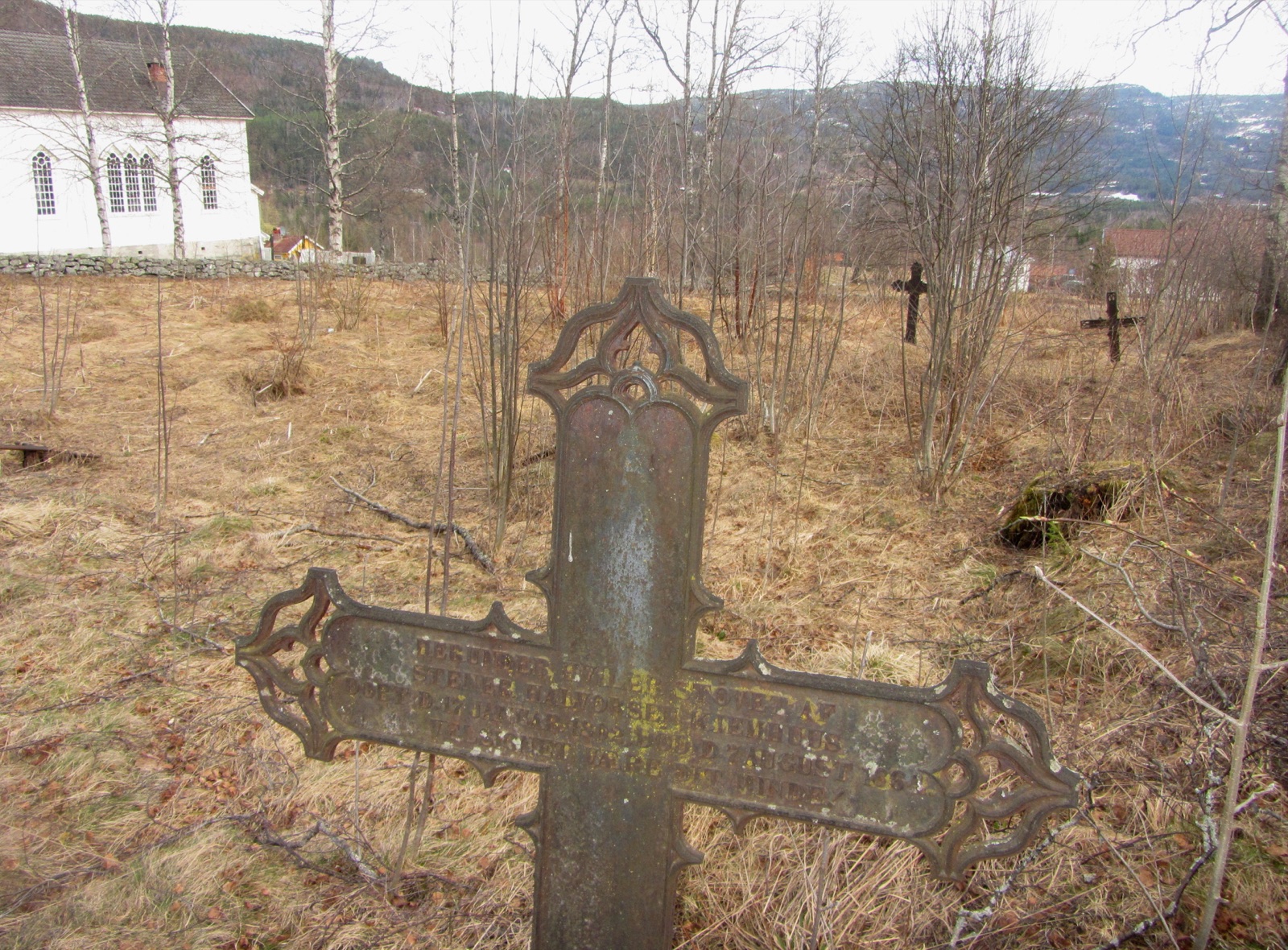
Credit
Photograph by Stig Rune Pedersen, 2014, CC BY-SA 3.0, from lokalhistoriewiki.no.Sources: Knut Hoff, Rollag bygdebok, vol. 1 (1988), Kjemhus, pp. 438–457, and Gladheim, pp. 355–387; Tov Flatin, Gamalt frå Numedal III (1918), pp. 102–104. The deed for Kjemhus, 1835, mortgage book I 13, fol. 267: the page. His burial, 1864, Veggli klokkerbok II 1, p. 212: the page. The 1865 and 1875 censuses. The cross: Norges kirker, Buskerud, vol. 1 (1981), Veggli kirke. The farm history credits the cross story to S. G. Mogan in Numedal Yearbook no. 7, but those pages turned out to be about the railway. The farm’s whole story is on the Kjemhus page.
Steinar is the central figure of The Wild Fiddler of Numedal, chapters 1, 4 and 5.
Halvor Steinarsen & Kjersti Tollefsdotter RuudGeneration 11 · 1835–1888›
Born Kjemhus Nordre, Veggli, Norway · Farmer, Timber merchant · Emigrated 1887 · Died Sandnes Twp, Yellow Medicine, MN · Lost Farm 1886
Inherited Kjemhus 1864. Guarantor losses + depression + failing health → sold farm 1886. Emigrated 1887 with entire family. Died within a year.
Kjersti (Feb 18 1844–1928): married 1868, Norway · born Ruud, Rollag, Norway · emigrated 1887
Kjersti: Christened April 7, 1844, daughter of Tollef Tollefsen of Ruud (Rollag parish register). Her father was the brother of Halvor’s mother, Kari, so she married her first cousin.
Siblings: Kristi Steinarsdotter (1832; Stayed in Norway. Married silversmith Ingebret Bakke/Landerud (1836-1926).), Helge Steinarsdotter (1833; Married Peder T. Lien. Emigrated to Rollag, MN.; emigrated 1880), Knut Stenersen Kjemhus (Dec 22 1838; First to emigrate (age 15). Wisconsin 15th Infantry, wounded Chickamauga. Re-enlisted 1st MN Heavy Artillery. Discharged Sergeant 1865. Homesteaded 1867.; emigrated 1854), Tollef Stenersen (1844; Died at age 3), Tollef Stenersen (1847; Named for brother who died. Owner of Landrud farm. Emigrated 1866—disappeared from all records.; emigrated 1866)
Halvor took over Kjemhus on his father Steinar’s death in 1864. On December 19, 1868, he married Kjersti Tollefsdotter of Ruud. The Bygdebok says Kjersti “was known for being a very beautiful woman.” Halvor was “an industrious and capable man”—in his youth a peddler, later running a forest and timber business alongside the farming.
The census of 1875 lists eight people at Kjemhus: Halvor and Kjersti, their sons Steinar and Tollef, his widowed mother Kari on her keep, a farm boy, Reier Thoresen, a maid, Ingeborg Danielsdatter, and a visitor, Gunder Nilsen, just back from America. They had two horses, seven cattle, two calves, fifteen sheep, and two pigs. They sowed two barrels of barley, two barrels of oats, five barrels of potatoes, and one-sixteenth barrel of root vegetables.
Despite their diligence, things collapsed. The Bygdebok says it plainly: “there was an economic downturn and guarantor liability that led to large losses. Halvor’s health also failed.” In 1886 he sold Kjemhus to Ole Larsen Gjermundstad, and the family moved to Nirigard. In May 1887 they left: the parish register lists Halvor, Kjersti and four children leaving Rollag, and the Christiania police protocol records them sailing on the Rollo on May 27. By October they were in Minnesota, where their son Peder was born at Dawson. Halvor died soon after: in 1887, his niece Margit wrote, or the next year, by the farm history.
Kjersti moved later to North Dakota and lived until 1928. “This entire old family, except Kristi Steinarsdotter Landrud, the father’s sister, went to America,” the farm history says. Entirely new people moved to the farm.
Children of Halvor & Kjersti (5): Steinar (1869–1907), Tollef (1871–1963—continued the direct line, took Kjemhus as his surname), Kari (1878–1964), Torstein (1883–1943), Peder (1887–1936, born in Minnesota; the farm history has him born in 1885)
Sources: Knut Hoff, Rollag bygdebok, vol. 1 (1988), Kjemhus, pp. 441–448. The 1865 census: the household. The marriage, 1868, Rollag ministerialbok I 9, p. 124: the page. The 1875 census: the household. The sale, 1886: the title index. Leaving the parish, 1887, Rollag ministerialbok I 11, pp. 224–225: the page. Sailing, 1887, Christiania police emigration protocol 14, p. 79: the page. Margit’s account: Aarbok for Numedalslaget 8 (1922), pp. 72–73.
Also in The Wild Fiddler of Numedal, chapter 6.
Tollef Halvorsen Kjemhus & Bergit KnudsdatterGeneration 12 · Jan 11 1871–1963›
Born Kjemhus, Veggli, Buskerud, Norway · Farmer · Emigrated 1887 · Died North Dakota
Left Norway age 16. Took the farm's name, Kjemhus, as his American surname. Spoke Norwegian his entire life. Called grandson 'gutten.'
Bergit (May 25 1887): married May 17 1906, Grand Forks, ND · born Norway
Siblings: Steinar Halvorson (c. 1869; Eldest son; emigrated 1887), Kari Halvorsdtr (Nelson) (Married, took name Nelson; emigrated 1887), Torstein Kjemhus (c. 1883; emigrated 1887), Peder Halvorson Kjemhus (c. 1885; Born in Minnesota in 1887, by the tree; the farm history has 1885, in Norway; emigrated 1887)
Tollef left Norway at sixteen, sailing in May 1887 with his parents and three siblings. The Bygdebok source ends at the gangplank—from here, the record is family memory, American documents, and the stories passed down.
On Syttende Mai—Norwegian Constitution Day—May 17, 1906, Tollef married Bergit Knudsdatter in Grand Forks, North Dakota. He carried the farm’s name across the Atlantic as his American surname, Kjemhus. He farmed in the Pembina Hills of Cavalier County, North Dakota.
Tollef spoke Norwegian his entire life. He called his grandson “gutten.” He lived to ninety-two, dying in 1963—a man born under Swedish-Norwegian union, raised in a Numedal valley, and buried on the Dakota prairie.
Children of Tollef & Bergit: Clara Regine (1907–c. 1997—first Kjemhus born in America)
Sources: Family records, North Dakota vital records, 1906 marriage record.
Also in The Wild Fiddler of Numedal, chapter 7.
Clara Regine Kjemhus & Christian AmothGeneration 13 · Jan 20 1907–c. 1997›
Born Fremont Twp, Cavalier County, ND · Farmer · Died Cavalier County, ND · 1st American-born Kjemhus
First Kjemhus born in America. Returned to Norway, sat on old benches at Kjemhus. Gave the cane sword to the son with the Kjemhus nose.
Christian (May 08 1903–Jul 27 1975): born Moscow Twp, Cavalier County, ND · died Langdon, Cavalier County, ND
Clara was the first Kjemhus born in America—January 20, 1907, in Fremont Township, Cavalier County, North Dakota. She married Christian Amoth, born May 8, 1903, on the family homestead in Moscow Township, Cavalier County. Christian died July 27, 1975.
Clara returned to Norway and sat on the old benches at Kjemhus. She kept a cane sword—a walking stick with a blade hidden inside—and gave it to the son with the Kjemhus nose. Seven children: Gerald died days after birth. Clara lived to approximately ninety.
Children of Clara & Christian (7): Carmen, Kenneth, Maureen “Pete” Bernell (continued the direct line), Ruthie, Gerald (d. infancy), Joyce, Judith
Sources: Family records, Cavalier County vital records. Birthplace, Fremont Township: family knowledge; the records say only North Dakota.
Also in The Wild Fiddler of Numedal, chapter 8.
Maureen “Pete” Bernell Amoth & Janie Amalene HollowayGeneration 14 · Jun 07 1933–May 19 2014›
Born Wales, Cavalier County, ND · Sales & Management, Entrepreneur · Died Blythewood, SC · Korean War Vet
Negotiated $10,000 raise before his first day. Had the Kjemhus nose—the same one Clara carried. A Stener move.
Janie (Jul 13 1930–Jan 03 2006): married Sep 6 1952 · born Randolph, Pontotoc County, MS
Born June 7, 1933, in Wales, Cavalier County, North Dakota—called “Teep” by family, known to everyone as Pete. He spent summers on the NumedahlNumedahl A Norwegian farming community in Cavalier County, North Dakota, named by its settlers after Numedal, the valley in Norway. Tollef Kjemhus farmed there, and his grandson Pete spent boyhood summers on his farm. Numedal and Numedahl → farm with grandfather Tollef, absorbing the Norwegian that still ran through the household. Korean War veteran.
Pete married Janie Amalene Holloway (July 13, 1930–January 3, 2006) from Randolph, Pontotoc County, on September 6, 1952, in Hernando, Mississippi. A career in sales and management—he negotiated a $10,000 raise before his first day at one position. Started his own companies. He had the Kjemhus nose—the same one Clara carried from Tollef, the same one Steinar carried from Halvor Persson. Pete received the cane sword from his mother. A Stener move, the book says.
Pete died May 19, 2014, in Blythewood, South Carolina.
Children of Pete & Janie (3): Pamela Kay, Carl Christian (continued the line, holds the cane sword), Mark Bernell (1964–2025)
Sources: Family records, military service records. The wedding: Pete’s biography in Wales and the Surrounding Area, 1897–1997 (1997), p. 305, and Carl.
Also in The Wild Fiddler of Numedal, chapter 8.
Carl Christian AmothGeneration 15›
Julianne (Apr 17 1961–Nov 17 2005): married Oct 7 1983 · born Dayton, Montgomery County, OH · also known as Julie Amoth · died Blythewood, Richland County, SC
Children: Christian Perry, Andrew Stephen
Children: Chase
Siblings: Pamela Kay, Mark Bernell (Jan 08 1964)
You are here. Photographer, author, genealogist. Lives on Bearwallow Mountain in western North Carolina. Married Julie Amoth (April 17, 1961–November 17, 2005) on October 7, 1983—two sons, Christian Perry and Andrew Stephen. Married Bev Chase.
Holder of the cane sword. Builder of this tree.
Author of The Wild Fiddler of Numedal: A Family History of the Kjemhus Line.
Source: The man who wrote all the rest of this down.
Christian Perry “Chris” Amoth & Jennifer MurphyGeneration 16›
Children: 2 not named here